
Direct Mail for eCommerce: The Playbook We Run at Magnet Monster
Over 50% of your customers will never open your emails. This isn't a deliverability issue or a subject line problem. It's natural channel behaviour. It plays out across every database, at every size, in every category. You cannot fix it with better copy or smarter segmentation.
What you can do is stop pretending email is enough.
Direct mail - sending physical postcards directly to your customers - is one of the most underused levers in retention marketing. It reaches close to 100% of the people it's sent to. It sits in a physical inbox with no algorithm, no spam filter, and no competition from fifty other brands landing in the same place at the same moment.
It is also more expensive than email. That changes how you use it. But used correctly, it prints money.
Below is the exact playbook we run at Magnet Monster.
Why direct mail belongs in your retention stack
The case for direct mail starts with a number most brands don't want to sit with.
If half your customer database is unreachable via email and SMS, you are leaving a significant portion of your potential returning customer revenue permanently on the table. Those are people who have already purchased from you. They know your brand. They have demonstrated buying intent. And you have no way to reach them.
Direct mail closes that gap.
A postcard that lands through the door gets seen. Not opened, not clicked, not delivered to a promotions tab. Seen. That changes the reach dynamic entirely and is why the channel is becoming an increasingly important part of the omnichannel retention stack we build for clients.
The cost is real. Direct mail runs between 50 cents and a dollar per send depending on format and volume. That means you cannot use it the way you use email. You have to be strategic about who you target, when you trigger it, and what offer you make when you do.
But for the right customers at the right moment, the ROI justifies it decisively.
How direct mail fits alongside email and SMS
The most important principle before getting into the specific playbooks: direct mail is a third touchpoint, not a first one.
The sequence is always the same.
- Email goes first. It is the most cost-efficient channel and reaches the broadest engaged segment.
- SMS goes second where consent exists, adding a complementary touchpoint for those who didn't respond to email.
- Direct mail goes third, targeting the customers who are unreachable or unresponsive on both of the above.
Apply this logic to every flow and every campaign. The segmentation question before any direct mail send should always be: which customers in this cohort cannot be reached via email or SMS? That is your direct mail audience. Starting there keeps the channel profitable and ensures you are not spending a dollar per postcard on customers you could have reached for pennies.
This is the same logic that underpins our broader omnichannel position at Magnet Monster. More touchpoints equal more impressions equal more revenue. But each touchpoint needs to earn its place based on cost, timing, and audience.
The 5 direct mail playbooks
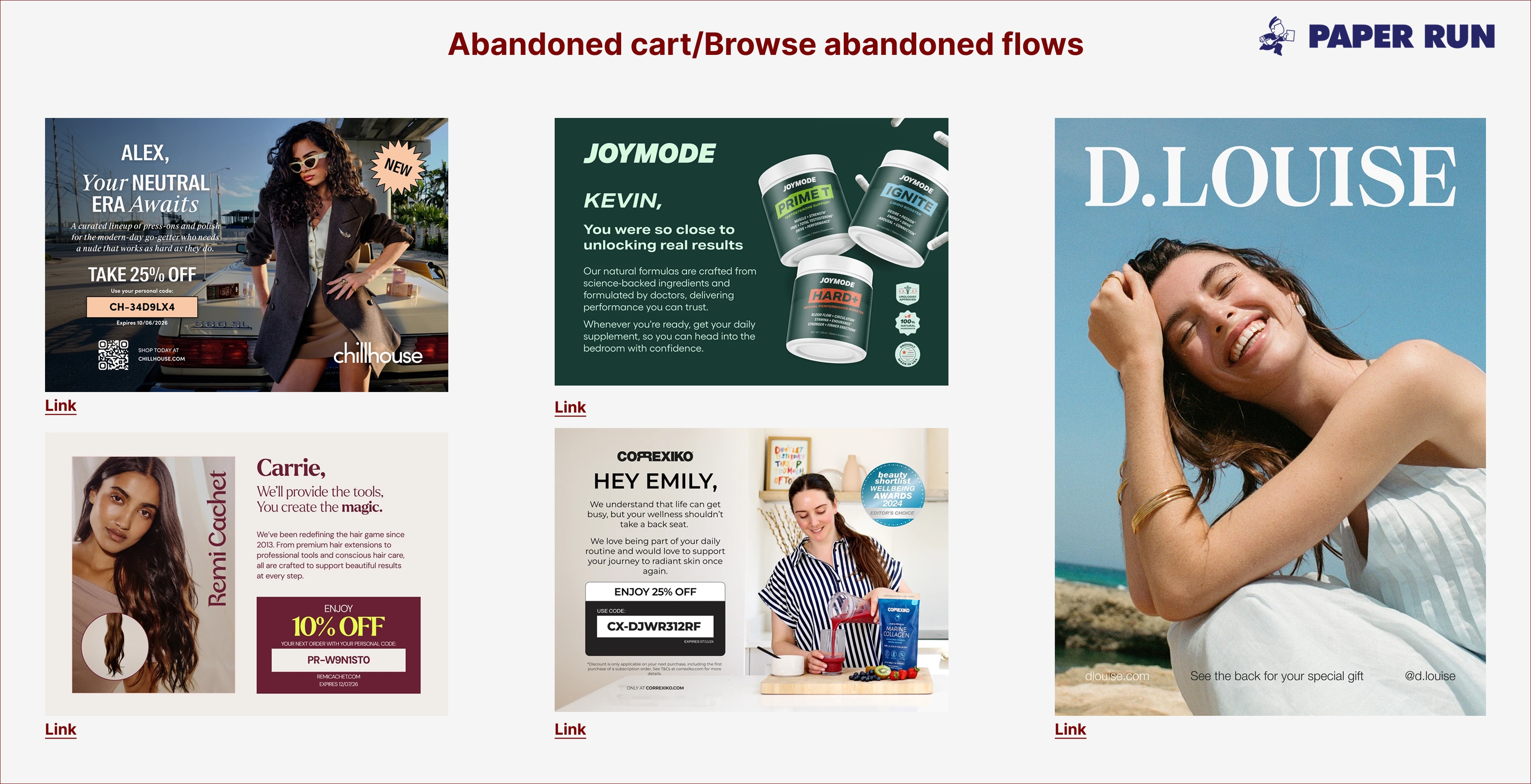
1. Abandoned cart
This is the most obvious starting point and the one with the clearest ROI signal.
Run it exactly as you would your email and SMS abandoned cart sequence. If a customer abandons a cart and doesn't respond to email or SMS within a set window, trigger a direct mail touchpoint as the final step in the flow.
The offer should mirror whatever you run for the brand elsewhere - a discount, free shipping, a gift with purchase. The postcard format gives you creative flexibility that email doesn't. Use it. A beautifully designed postcard with a clear offer and a QR code back to the cart will consistently outperform a generic email for the customers it reaches.
One rule: direct mail should be the last touchpoint in the abandoned cart sequence, not the first. You do not need to spend a dollar reaching someone you could have recovered for free.
2. Win-back campaigns
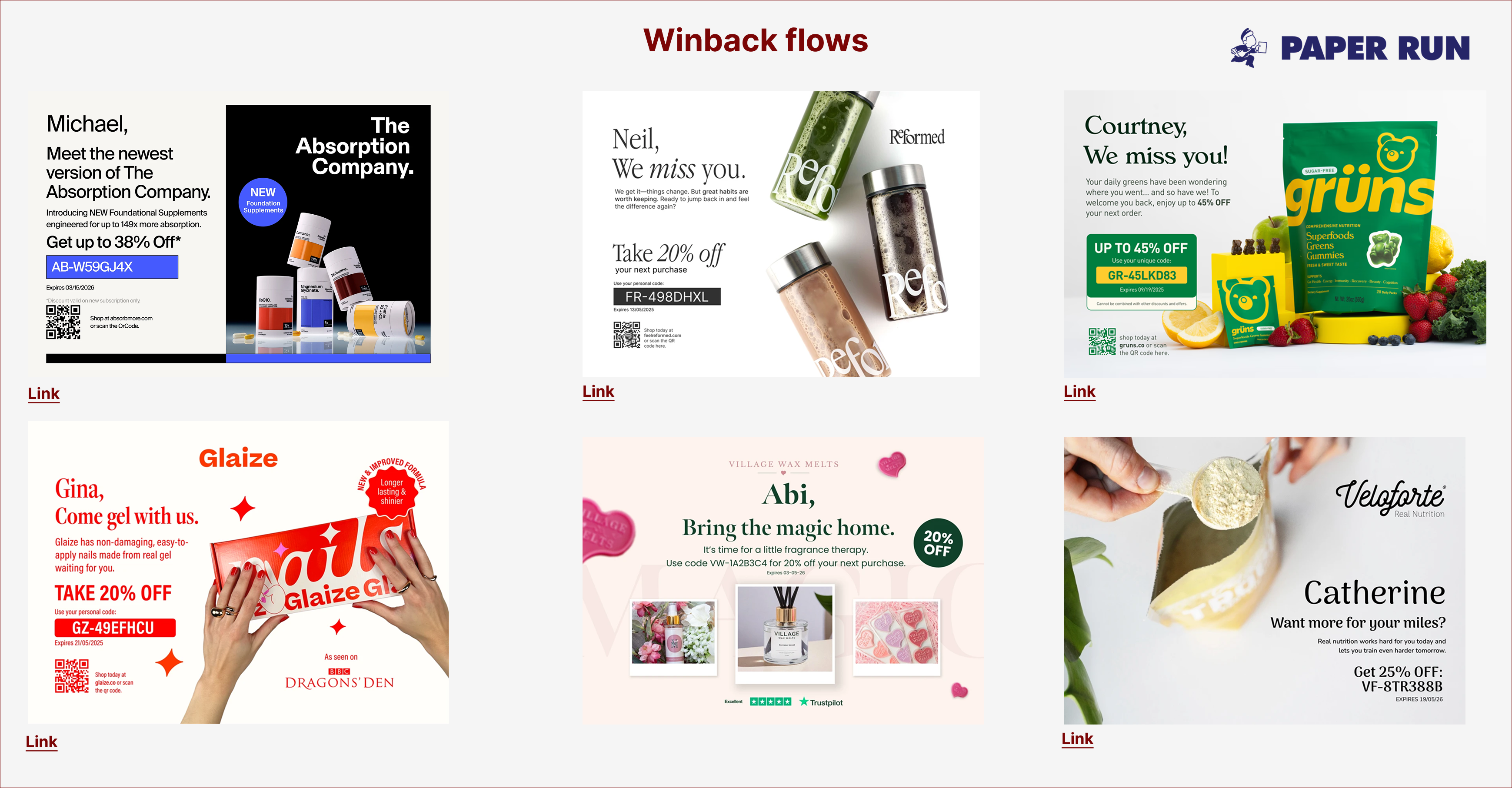
The win-back playbook for direct mail follows the same logic as abandoned cart but requires more discipline around segmentation.
Not all lapsed customers are worth targeting. This is a mistake I've made myself when auditing new accounts - pulling a broad cohort of historical repeat buyers and sending to all of them without applying an RFM filter first.
RFM stands for recency, frequency, and monetary value. It matters here because a customer who lapsed three years ago is a fundamentally different target to a customer who lapsed 90 days ago. The probability of winning back a deeply lapsed customer is low regardless of the channel you reach them on. Spending a dollar per postcard on them is rarely profitable.
The approach I recommend:
- Start with customers who have a high historical LTV and whose last purchase was within 90-180 days
- Run the campaign and measure incrementality - the net new revenue the channel adds
- If it's positive, expand the window to 180-365 days
- Keep expanding until you hit the point where it stops being profitable, then rein it back in
Start narrow. Expand based on evidence. This is the most cost-efficient way to find the profitable ceiling for the channel with your specific customer base.
For the offer, go in with your best incentive. The cost of the send means you want to maximise the chance of conversion on each postcard. A weak offer on an expensive channel is a poor trade.
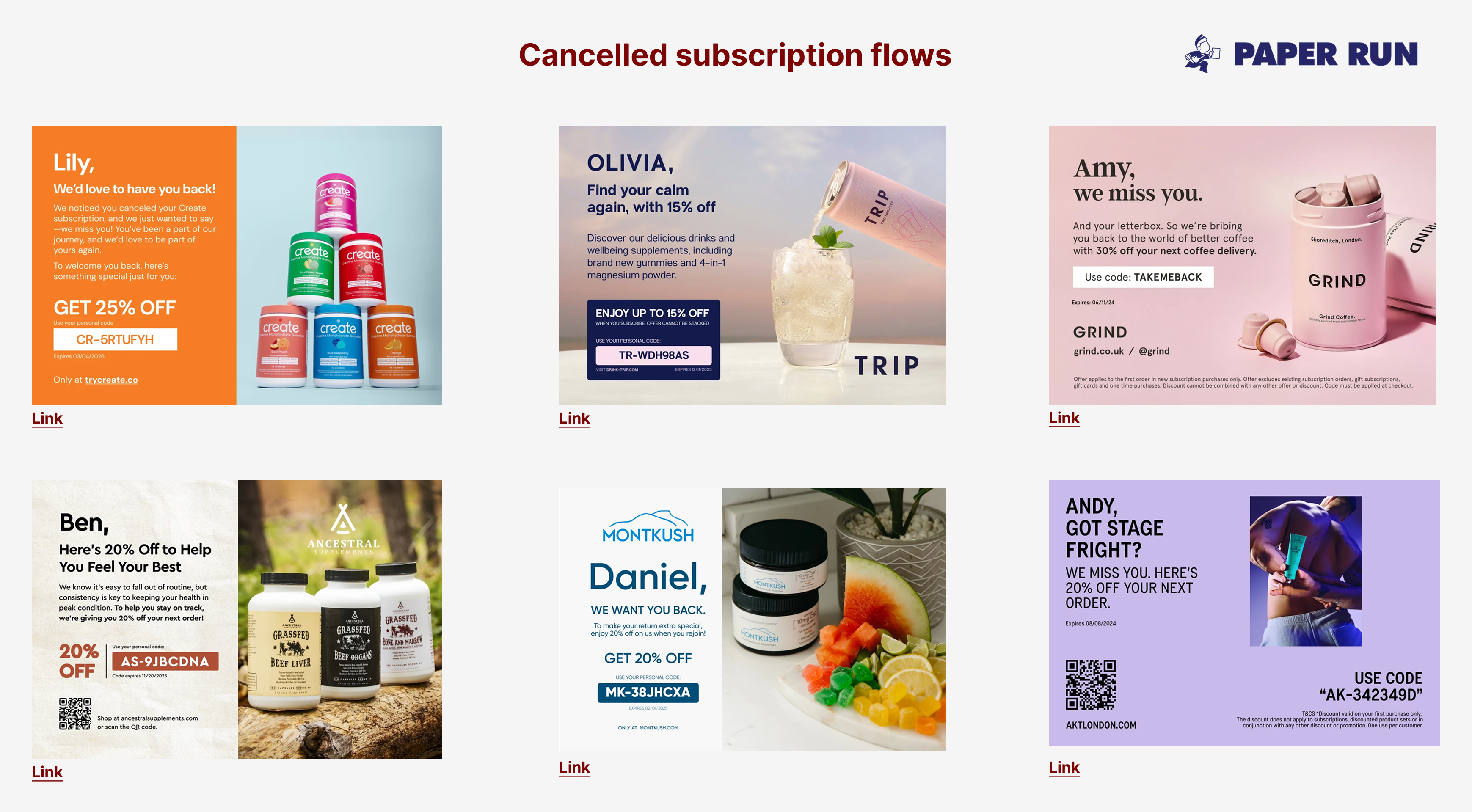
3. Subscription win-back by cancellation reason
This is where direct mail gets genuinely powerful for subscription brands and where most brands leave the most money on the table.
A generic win-back postcard for a churned subscriber will work to a point. But if your subscription platform captures cancellation reasons - and most do - you can go significantly more granular and that granularity drives better returns.
Examples of how this works in practice:
- Customer cancelled because of taste: send a postcard announcing new flavours
- Customer cancelled because they didn't get results: send a postcard addressing the formulation, the science, or the correct usage instructions
- Customer cancelled because of price: lead with a discount or a restructured subscription offer
The cancellation reason tells you exactly what objection lost this customer. Your postcard should address that specific objection, not a generic version of it. This level of targeting is what separates a direct mail strategy that breaks even from one that generates real incremental revenue.
4. One-time purchase to subscription upsell
This is one of the most high-leverage direct mail flows to set up and one of my personal favourites.
The data is consistent across the brands we work with: subscribers have an LTV two to three times higher than one-time purchasers. And customers who make their first purchase on a one-time basis and then convert to a subscription are consistently among the highest LTV customers in any database.
The direct mail opportunity here is targeting one-time purchasers who cannot be reached via email or SMS and sending them a postcard designed to convert them onto a subscription.
Timing matters significantly. Send around day 30, calibrated to the consumption cycle of the product. The longer you wait, the more likely it is that the customer has quietly churned. One-time purchasers skew toward light buyers, and with every passing day the window for conversion narrows.
The format that works especially well here is a handwritten-style postcard from the founder. Paper Run and other direct mail platforms can produce these at scale and they look genuinely personal. The personal touch matters when you are asking someone to commit to a subscription.
The LTV upside on converting these customers justifies being aggressive with the spend. Measure it properly. The return is almost always there.

5. Campaign-based sends: new product drops and seasonal promotions
The final playbook is the simplest and the one most brands overlook because it feels less sophisticated than automated flows.
Every time you have a new product drop, a new flavour, a new line, or a major seasonal promotion like Black Friday or Christmas, you are already sending campaigns via email. The direct mail version of this is targeting the cohort of high-value customers you cannot reach on email and SMS and sending them a postcard about the same campaign.
These are customers who have demonstrated high LTV in the past. They have not churned because they dislike your brand. They have simply drifted out of your reachable audience. A new product that is genuinely relevant to them is often all that is needed to bring them back.
Do not assume that because someone is unresponsive on email they are permanently lost. They are not. They are just unreachable via the channels you have been relying on.
A postcard sent at a high-leverage campaign moment costs a dollar. A returning high-LTV customer is worth multiples of that. The maths works.

The segmentation principle that applies across all five playbooks
Every direct mail send at Magnet Monster starts with the same question: which customers in this cohort have a high historical LTV and cannot be reached via email or SMS?
That question does two things simultaneously. It maximises the revenue potential of each send by targeting customers most likely to generate significant return. And it keeps the channel cost-efficient by ensuring you are not spending on customers you could reach for free elsewhere.
The active customer file is the primary determinant of returning customer revenue. Direct mail is one of the most effective tools available for protecting and expanding that file by reaching the customers your other channels cannot.
If you are only running email and SMS and accepting that half your database is unreachable, you are leaving a significant amount of compounding LTV on the table. The channel exists. The technology to execute it at scale within a week exists. The only thing missing is the decision to start.
Don't miss: 7 Ways to Add Direct Mail to Your Klaviyo Program (The Easiest Revenue You'll Ever Make)
Getting started
Every playbook above can be live within a week using a direct mail platform like Paper Run, who we use across our client base at Magnet Monster. They handle design, fulfilment, and integration with your existing flows.
Start with one playbook. The abandoned cart flow or a win-back campaign targeting 90-180 day lapsed customers with high historical LTV are both strong starting points. Measure the incrementality. If the channel is positive, expand.
If it doesn't work, you can turn it off. But if you don't try, you will never know what revenue you are leaving behind.
FAQs
How much does direct mail cost for eCommerce brands?
Direct mail typically costs between 50 cents and a dollar per send, depending on format, volume, and the platform you use. This is significantly more expensive than email, which is why segmentation discipline is critical. The channel is most profitable when targeted at high-LTV customers who are unreachable via email and SMS rather than used as a broad broadcast channel.
When should direct mail be used in an abandoned cart sequence?
Direct mail should always be the last touchpoint in an abandoned cart sequence, not the first. Email goes first, SMS second where consent exists, and direct mail third for customers who have not responded to either. Using it as a final touchpoint rather than a first one keeps the channel cost-efficient and ensures you are not spending a dollar on a recovery you could have achieved for free.
Does direct mail work for subscription eCommerce brands?
Yes, and it works best when the send is personalised to the cancellation reason. Generic win-back postcards perform adequately. Postcards that address the specific reason a subscriber cancelled - taste, results, price, or product fit - perform significantly better. Most subscription platforms capture cancellation reasons. Using that data to personalise the direct mail send is the single biggest lever for improving ROI on the channel for subscription brands.
How do you measure whether direct mail is working?
Measure incrementality - the net new revenue the channel generates above what email and SMS would have recovered without it. QR codes and unique discount codes on each postcard make attribution straightforward. Start with a narrow, high-LTV segment, measure the return, and expand the targeting window only if the channel is demonstrably profitable at each stage.
Is direct mail only for large eCommerce brands?
No, but it requires a sufficient active customer base and a clear segmentation strategy to be cost-efficient. The minimum viable use case is a brand with a meaningful cohort of high-LTV customers who are unresponsive on email and SMS. At that point, the cost per send is justified by the LTV of the customers being targeted. Brands without that cohort yet are better served focusing on building their email and SMS lists first.
How does direct mail fit into an omnichannel retention strategy?
Direct mail is the third channel in the retention stack, after email and SMS. It reaches the customers those channels cannot, which makes it additive rather than competitive. The brands building the most resilient returning customer revenue are the ones collecting consent across email, SMS, WhatsApp, and direct mail and using each channel for what it does best. Direct mail's contribution is reach - it gets seen by customers who would otherwise be permanently outside your retention strategy.
Paper Run is Magnet Monster's direct mail partner. All examples in this post were executed through their platform. They can have your first direct mail flow live within seven days.
Related reads:

.svg)





1.png)
.png)