We build retention programmes for a living. So every year, dozens of subscription brands approach us for auditing their marketing because their take rates have fallen.
Most of them blame their flows for it.
But that's not where the problem is.
Your subscription take rate isn't a retention problem.
It's an AOV decision your product page already made, months before you emailed a customer about cancelling.
We put this argument to Ben Sharf, co-founder of Platter, the Shopify storefront partner behind 200+ storefronts and more than $1 billion in GMV.
He concurred, pointing out a key dynamic we hadn't fully appreciated until he mentioned it.
As Ben highlighted, deciding to accept a subscription offer is essentially an AOV choice disguised as a subscription commitment.
A subscription offer gets bought on the same page, in the same layout, using the same decision-making a customer applies to a one-off purchase.
If that page buries the subscription option, confuses the format or flavour choice, or makes managing the plan harder than cancelling it, no email sequence fixes that afterwards.
What actually decides your subscription take rate?
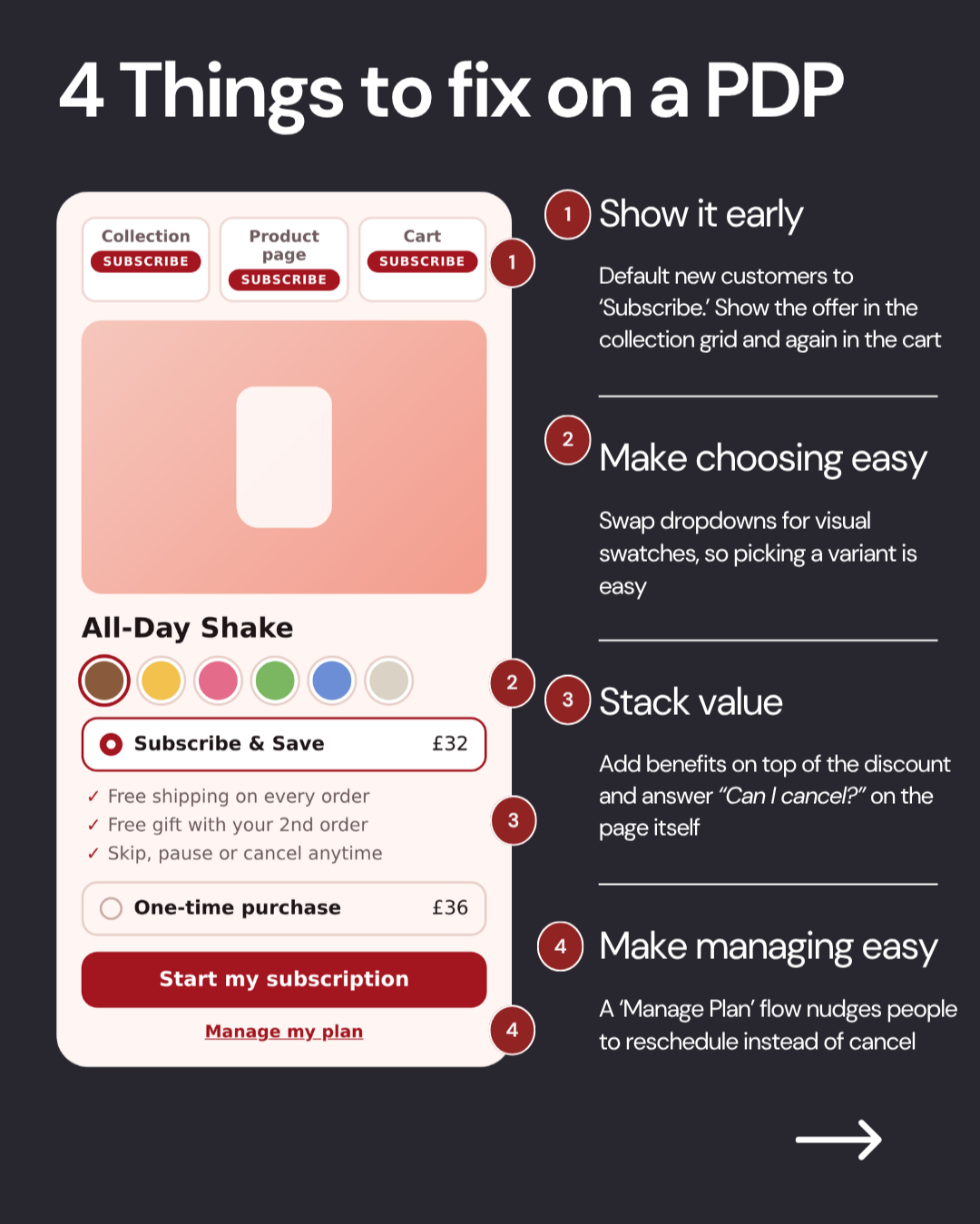
Four decisions on the product page, made before checkout, decide most of your subscription take rate.
We pulled the examples below from Platter's own case studies, because we'd rather quote real numbers than invent a framework and hope it holds up.
The four pillars of a high-converting subscription PDP
1. Make the subscription option impossible to miss before the PDP even loads
Instead of waiting for shoppers to stumble upon a subscription offer after landing on the product page and scrolling through details, you need to introduce your offer earlier:
- In the collection grid
- In the cart
- Sometimes before the customer has picked a product at all
Three things work here, and none of them are complicated.
- New customers get the subscription option by default rather than making them opt in
- Introduce the subscription offer before the product page, not just on it
- Bring up the subscription option again in the cart, for anyone who missed it the first time
The logic holds because subscribers are worth roughly 3x more than one-time buyers, so every point of take rate you win before checkout is worth defending with more than one shot at the customer's attention.
Takeaway: Put the subscription offer in front of the customer more than once, starting before they ever reach the product page.
2. Make the full range effortless to choose
A lot of brands get this wrong without realising it, because it looks like a small UI decision rather than a retention lever.
Good Protein, a vegan protein and superfood subscription brand, had this exact problem. They sell their All-in-One Shake in more than a dozen flavours, but for years the full range lived behind a single dropdown.
Picking a different flavour reloaded the whole page and dropped the customer back to the top, so exploring the range cost time most people don't want to spend.
Platter's rebuild replaced that dropdown with flavour-first visual swatches, each with its own product photography and its own colour scheme that changes the page around it.
Good Protein's first-order subscription rate rose 67% after that rebuild went live, alongside a new bundle widget and the subscription management flow covered in pillar 4 below.
But it's the one change built specifically to fix how a customer chooses what they're buying, and if that choice still feels like filling out a form, it causes friction when the customer makes a subscription decision.
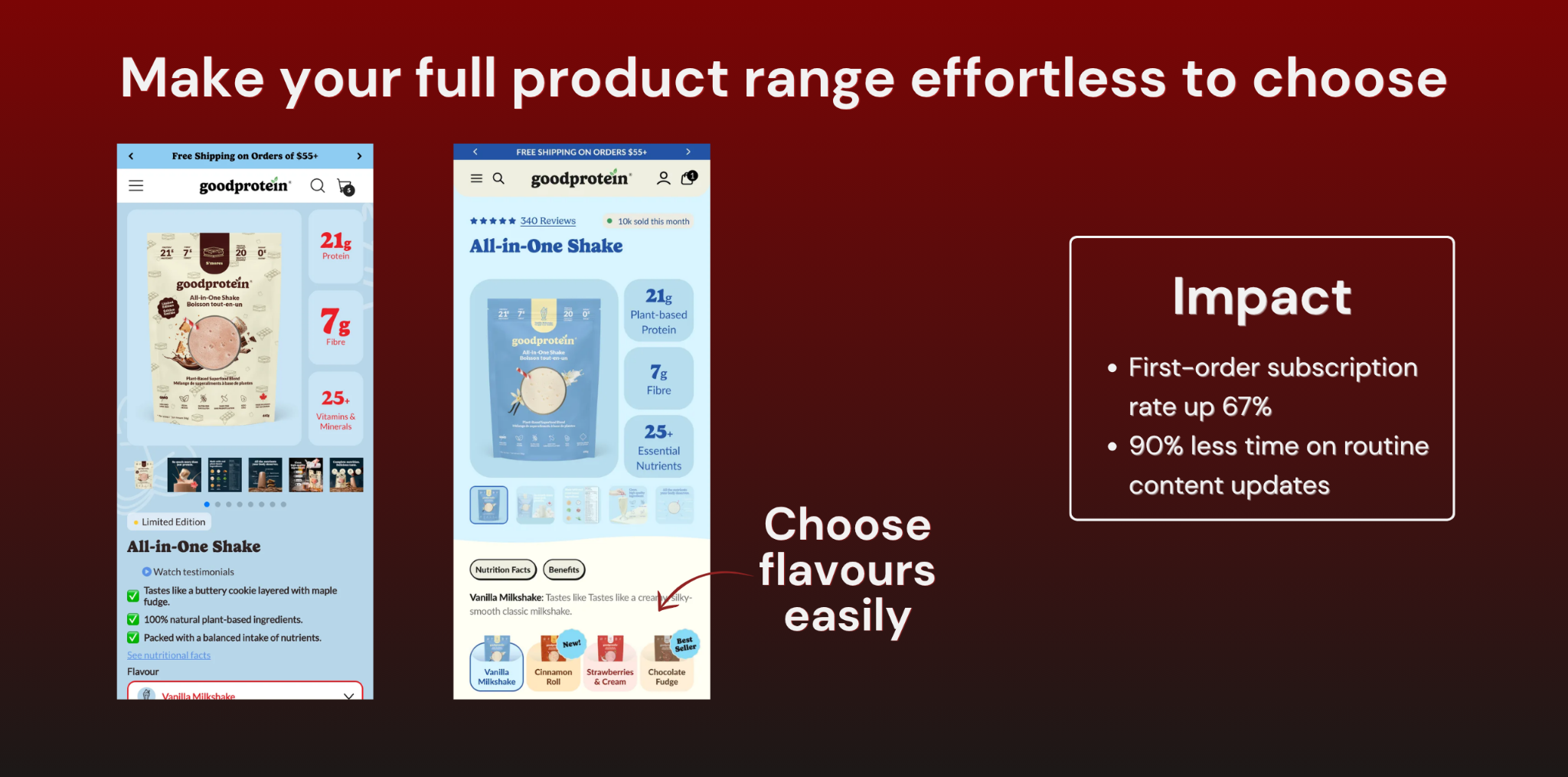
Takeaway: If choosing a variant still feels like filling out a form, that's where your subscription decision is being lost.
3. Justify the commitment with stacked value
Once the subscription option is visible and the range is easy to choose from, the next objection is simple: why commit at all?
Relying solely on a price cut is a common approach for DTC brands, but price drops on their own seldom drive the subscriber adoption rates that they anticipate.
Two things move it further:
- Stack visible benefits on top of the discount, such as free shipping, early access, or bundled extras, so the customer is weighing a package rather than a percentage
- Answer the cancellation question before the customer has to ask it, directly on the page, so flexibility becomes a reason to say yes rather than a worry that stops them in their tracks
Takeaway: Customers subscribe when the commitment feels lower risk than staying a one-time buyer.
4. Make managing the plan easier than cancelling it
This is the pillar that closes the loop, and it's the one most retention teams never get near because it happens on the storefront instead of an email.
Good Protein's old subscription setup needed roughly 30 separate product templates, and every routine update, a new flavour, a price change, took two to three hours and around 25 edits.
Platter rebuilt it on three templates with a custom Loop integration that guides customers through a "Manage Plan" flow, nudging them toward rescheduling their next order rather than cancelling outright.
Routine updates now take 10 to 15 minutes and around 3 edits, a 90% reduction in admin time and an 88% drop in edits needed.
The Absorption Company took a similar approach with a single master PDP template and a staggered subscription cadence by product type, and saw a 15% increase in subscription take rate.
Their co-founder, Nathan Medow, described the difference this way: "It's like having a Ferrari instead of a bike. The whole team loves it!"
Every one of those saved hours is time your team gets back for the customers you're actually trying to keep, not the admin your storefront should have handled itself.
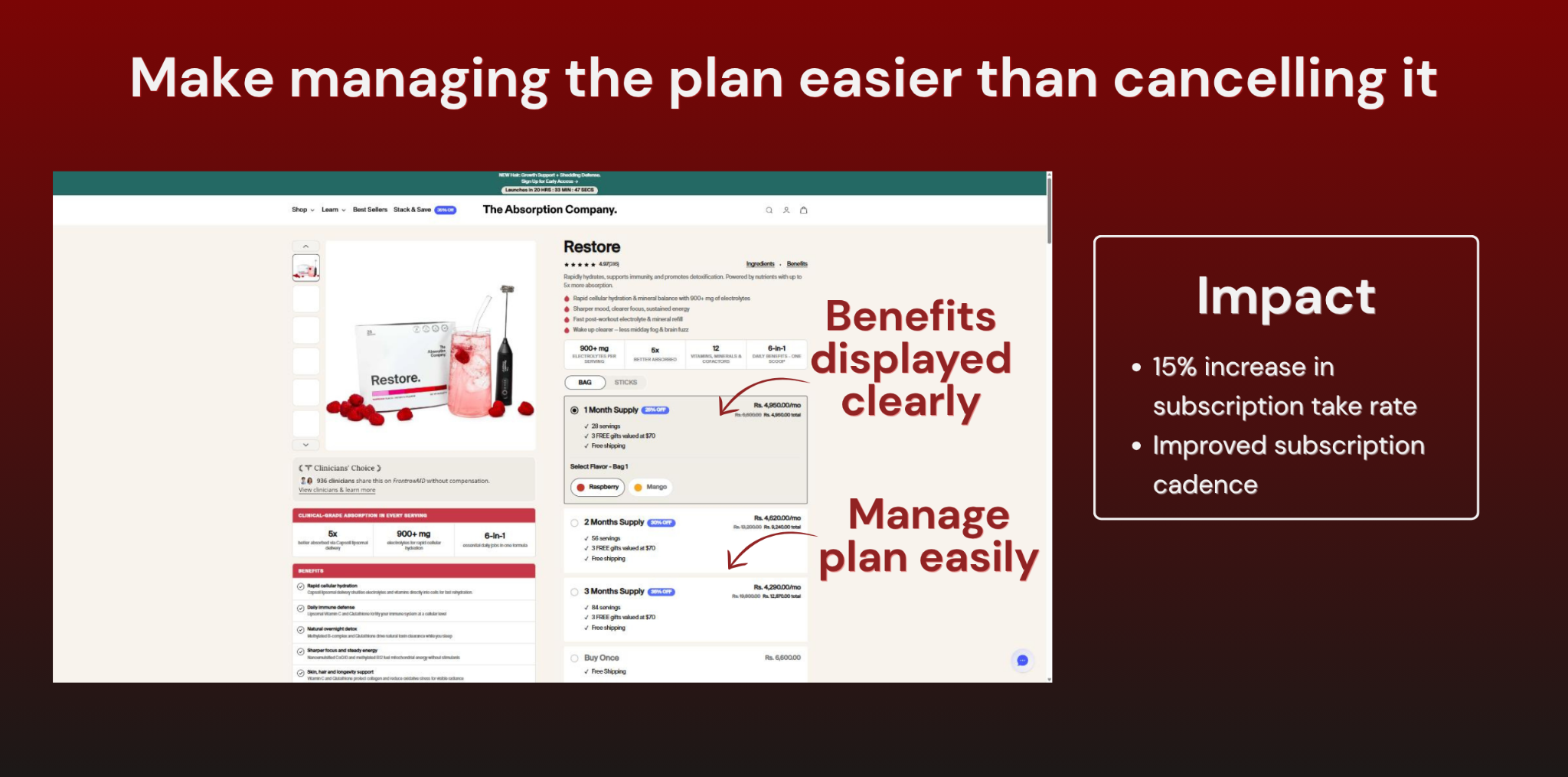
Takeaway: If managing a subscription takes longer than cancelling it, you're spending admin hours to lose customers you already won.
Where this leaves your flows
Retention marketing isn't replaced by any of this.
Crucial touchpoints such as post-subscribe welcome flows, shipment updates, and win-back sequences, still remain essential.
However, their impact is ultimately downstream of the initial choices shaped by the PDP.
Fix the page first, and your flows get a better subscriber to work with from day one, instead of trying to talk someone back into a decision the page talked them out of.
If you're not sure whether your subscription take rate is a page problem or a flow problem, that's exactly what our subscription audits are built to find. Get in touch with us.
FAQ
What is PDP optimisation?
PDP optimisation is the process of improving a product detail page, the page a customer uses to choose a product and how they want to buy it, so more visitors convert once they land there.
What does PDP mean in marketing?
PDP stands for product detail page. It's the individual product page a customer reaches from a collection grid, an ad, or a search result, where they make the final decision to buy.
How do you design a product page for a subscription offer?
Introduce the subscription option before the customer reaches the page, make every variant or flavour choice visual rather than buried in a dropdown, stack visible benefits alongside any discount, and make managing the plan at least as easy as cancelling it.
What should a subscription product page look like?
It should make the subscription option visible immediately, let the customer choose their exact variant without friction, justify the commitment with more than a discount, and link clearly to a plan management flow rather than hiding it behind support.
What is a subscription take rate?
Subscription take rate is the percentage of customers who choose the subscription option instead of a one-time purchase, and it's decided far more by the product page than by anything sent after checkout.
Want more of this in your inbox? Subscribe to our newsletter and YouTube channel for weekly DTC retention strategies, extracted straight from the brands we work with. No fluff, just actionable plays.