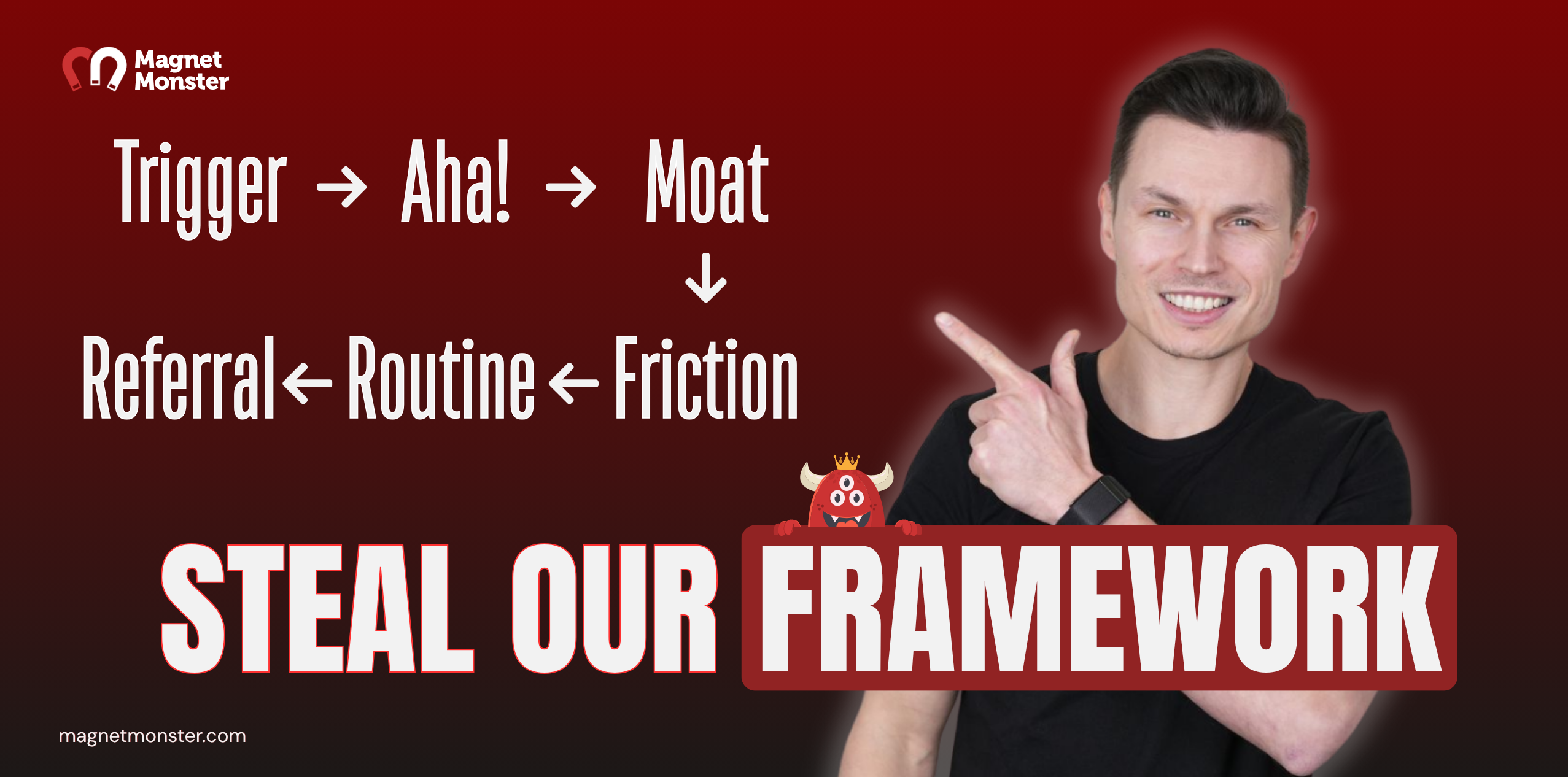

The Jobs To Be Done framework increases customer lifetime value by revealing why your best customers actually bought, what made the product stick, and what nearly stopped them. The six survey questions below collect this as zero-party data from your highest-value eCommerce customers, and every answer maps to a specific LTV lever: acquisition angles, onboarding, churn prevention, conversion fixes, replenishment timing and referral copy.
I'm about to give you the secret sauce we use at Magnet Monster to increase lifetime value for every eCommerce brand that walks through the door.
It's a bastardised version of the classic Jobs To Be Done framework. Six questions, sent to your best customers.
The answers to these questions focus on: your acquisition messaging, conversion rate, flows, customer service, and how customers actually use the product.
So, this way you have authentic data in your hands instead of running on guesswork and assumptions.
What is the Jobs To Be Done framework in eCommerce?
Jobs To Be Done is a research approach built on a simple idea: customers don't buy products, they hire them to do a job.
The framework itself was popularised by Clayton Christensen and it's been a product development staple for years.
What we've done is strip it down into a six-question survey built specifically for DTC brands, where every answer maps directly to a part of the customer journey you can actually improve. For example, the trigger feeds your ads, while the friction feeds your cart abandonment flow, and the routine feeds your replenishment timing.
That mapping is the whole point. Qualitative research that doesn't change what you send is just a nice deck.
Who should you send customer research surveys to?
This is the part DTC brands get wrong.
You want to send this to your best customers who satisfy the below criteria:
- Customers with at least 3 to 5 orders over all time, or a monetary threshold that fits your category
- Weighted towards recent customers, because memory fades and so does relevance
And be realistic about response rates. Survey responses over email are not high, even from your best customers. You need the sample size to make the exercise work, so send it wide within your criteria.
You can deploy it manually via campaigns, or automate it to trigger when a customer hits VIP status. You can also lift individual questions into pop-ups and post-purchase surveys.
One more option worth experimenting with: AI customer agents that call customers and conduct the research on your behalf. Any way you can get these questions in front of customers, pursue it. The more data you collect, the better.
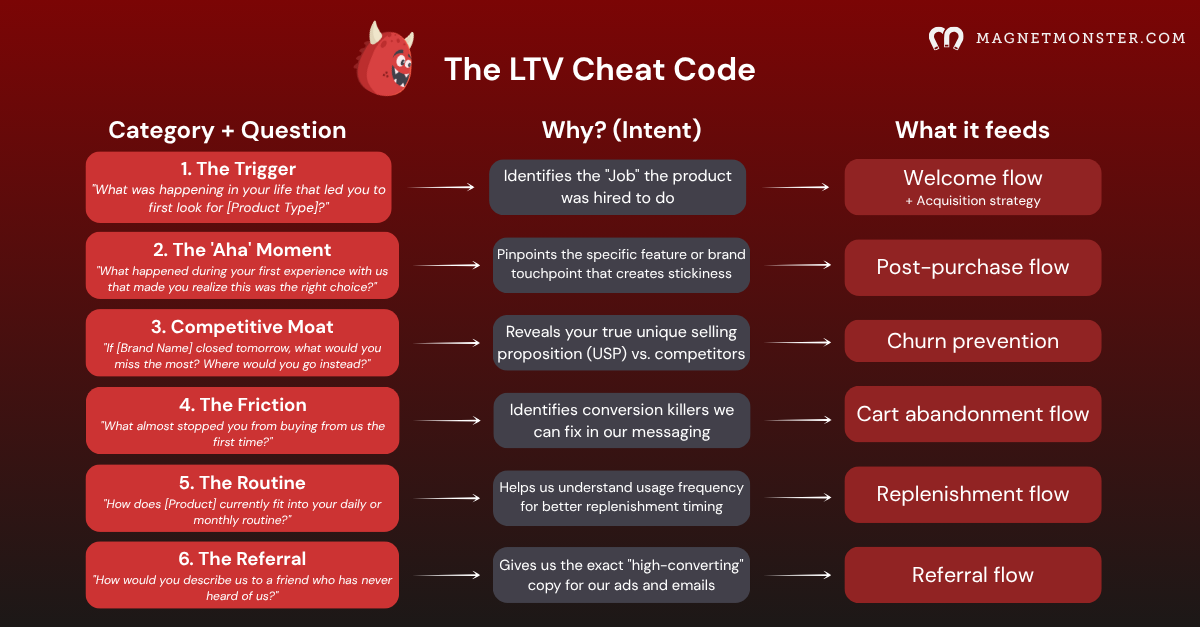
The six questions (and what each one feeds)
1. The Trigger
"What was happening in your life that led you to first look for [product type]?"
This identifies the job the product was hired to do. The core reason customers seek out what you sell.
Start here, because everything is downstream of the reason they bought.
The answers feed your welcome flow, but more importantly they feed acquisition. Find the pain point, then double down on hooks and angles that bring more of these customers through the door.
Read: How to Email Active Subscribers to Grow LTV for DTC Subscription Brands
2. The Aha Moment
"What happened during your first experience with us that made you realise this was the right choice?"
This pinpoints the specific feature or touchpoint that creates stickiness.
A lot of retention is determined by the very first interaction. If you know what makes the product click, you make it unmissable in the onboarding, and repeat purchase improves as a byproduct.
It feeds your post-purchase flow.
3. The Competitive Moat
"If our brand closed tomorrow, what would you miss most? Where would you go instead?"
You already know who your competitors are. What you don't know is why customers trust you over them. That's the differentiation to double down on if you want market share.
One important note: don't get sensitive when the answers show your customers shopping elsewhere. Decades of research from the Ehrenberg-Bass Institute shows buyers in every category purchase from several brands. It's natural market behaviour and you can't change it.
What you can do is make the points of difference impossible to miss. It helps you to prevent churn.
Don't missi: Retention Marketing Strategy: A Practical Playbook by Business Model
4. The Friction
"What almost stopped you from buying from us the first time?"
CRO specialists ask this constantly, and for good reason. It surfaces the conversion killers you can fix in your messaging.
The question helps you create your cart abandonment flow and every landing page you run traffic to.
5. The Routine
"How does [product] currently fit into your daily or monthly routine?"
This tells you the real usage frequency, which means better replenishment timing. It also tells you whether customers are actually adhering to the reason they bought.
Customers who use the product get results → they come back with or without marketing.
It feeds the replenishment flow and the post-purchase journey.
Read: Post-Purchase Email Flows: Convert One-Time Buyers Into Brand Advocates
6. The Referral
"How would you describe us to a friend who has never heard of us?"
This gives you the exact high-converting copy for your ads and emails, in your customers' own words.
It also gives you testimonial snippets for referral campaigns, and an honest assessment on the sentiment your brand evokes.
It feeds your ad creatives, email copy, and the referral flow.
How does the Jobs To Be Done framework increase customer lifetime value?
First interpret → then implement. The framework only pays off if the answers change what you actually ship:
- Trigger answers become acquisition hooks and welcome flow messaging
- ‘Aha’ moment answers restructure your onboarding priorities
- Moat answers become the differentiation you hammer in retention comms
- Friction answers rewrite your cart abandonment flow and PDPs
- Routine answers set your replenishment timing
- Referral answers get lifted, lightly edited, and shipped as ad copy
Run the responses through AI to extract the top objections, benefits and phrases, and the interpretation stage takes minutes rather than days.
Everything from your creatives to your product pages to your retention strategy should be shaped by what comes back.
That's how you build an email programme on data and evidence.
For subscription brands specifically, this framework does double duty. The moat and friction answers usually mirror your cancellation reasons, which means you can fix objections before they become churn rather than after. And the routine question tells you whether your billing cadence matches actual consumption, which is the root cause behind most "too much product" cancellations. Run the survey on subscribers who've passed their third order and the answers feed directly into the cross-sell and upsell strategy for your highest-LTV segment.
Frequently asked questions
What is the Jobs To Be Done framework?
Jobs To Be Done is a research framework built on the idea that customers hire products to do a specific job rather than buying them for features. Popularised by Clayton Christensen, it's used to uncover the real motivation behind a purchase. In eCommerce, the most practical application is a short survey sent to your best customers, with each answer mapped to a specific part of the customer journey you can improve.
What are the best post-purchase survey questions for eCommerce?
The six highest-leverage questions are: what was happening in your life that led you to look for this product, what made you realise we were the right choice, what would you miss if we closed tomorrow, what almost stopped you buying the first time, how does the product fit into your routine, and how would you describe us to a friend. Each maps to a specific output: acquisition angles, onboarding, differentiation, conversion fixes, replenishment timing, and ad copy.
Who should receive customer feedback questions?
Your best customers, defined by guardrails like 3 to 5 lifetime orders or a monetary threshold suited to your category, weighted towards recent purchasers. Response rates over email are low even among loyal customers, so send wide within your criteria to build a workable sample. Trigger the survey manually via campaigns or automatically when a customer reaches VIP status.
How do you collect zero-party data in eCommerce?
Through direct questions customers answer intentionally: surveys, quizzes, pop-ups and post-purchase flows. The six Jobs To Be Done questions are among the highest-value zero-party data you can collect because they reveal motivation, friction and usage rather than surface preferences. That's the data that improves acquisition targeting, retention messaging and product development, and no analytics platform can infer it for you.
How do you increase customer lifetime value in eCommerce?
Start with why your best customers bought and what made the product stick, because every LTV lever sits downstream of that. The practical sequence: survey your highest-value customers with the six Jobs To Be Done questions, use the trigger and aha moment answers to acquire more customers like them and onboard them properly, fix the friction points that suppress conversion, time replenishment to actual usage, and double down on the differentiation that stops them switching. LTV grows as a byproduct of customers extracting more value, not from sending more promotions.
How does this framework grow subscription LTV?
Subscription churn is usually a product adoption problem wearing a price costume, and the routine question exposes it: if customers aren't using the product at the billing cadence, they accumulate stock and cancel. The moat and friction answers typically mirror your cancellation reasons, letting you address objections in onboarding rather than in the cancellation flow. Run the survey on subscribers past their third order, when churn has stabilised and they've become your most valuable research pool.
How many survey responses do you need for the answers to be useful?
Enough to see patterns repeat, which matters more than a fixed number. Email survey response rates are low, so the practical approach is widening the send within your best-customer criteria rather than lowering the bar on who qualifies. If volume is still thin, add the questions to post-purchase surveys and pop-ups, or use AI customer agents to run the questions by phone.
Conclusion
The problem why most brands skip this work is because it's slower than shipping another flow and harder to screenshot for a report. They think they could earn extra money instead of spending time and effort in finding answers to these questions.
Which is exactly why I feel it's an edge.
Deploy the survey, interpret the answers properly, and you'll find differentiating perspectives you simply haven't considered.
P.S - If you only implement one question, make it the trigger. Everything is downstream of the reason they bought.
Want more of this in your inbox? Subscribe to our newsletter and YouTube channel for weekly DTC retention strategies, extracted straight from the brands we work with. No fluff, just actionable plays.

.svg)


1.png)
.png)