-Magnet%20Monster.png)

I audited a nine-figure DTC brand last month and found something that should worry every operator about to hire a "retention agency."
80% of their first-purchase customer acquisitions were bundles.
Bundling is supposed to be a safe bet. Higher AOV on the first order, higher lifetime value (LTV) down the line. It's one of the most frequently recommended acquisition tactics in eCommerce.
For this brand, it was hurting their lifetime value. So, while it wasn’t a retention issue, It's an acquisition problem in the garb of retention.
I’ve seen this play out so many times in the last 18 years - This is exactly why DTC brands who hire an email marketing agency to fix a declining repeat purchase rate end up disappointed.
What they usually get is real, and it does add value: customers who are already happy, buying a little more.
What they wanted was a fix for customers who never come back at all.
But you need to remember that those are two different jobs. Email can only do one of them.
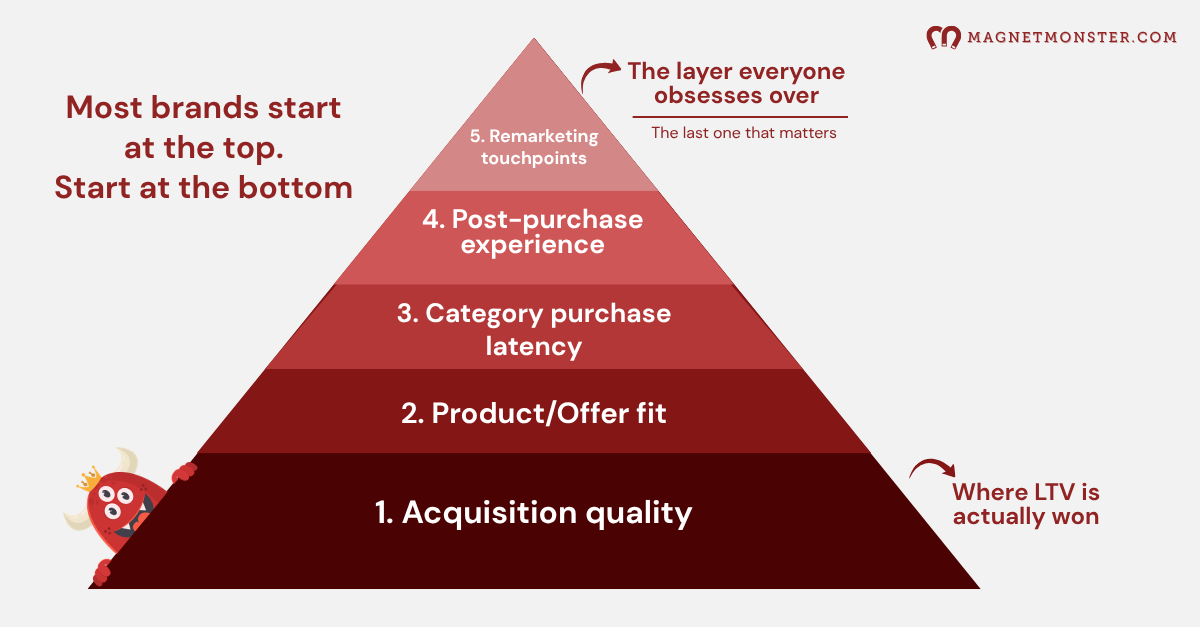
Retention is downstream of five structural levels, and email sits at the top of the stack and agencies start there and work their way down. At Magnet Monster, we start at the bottom and work up.
What is retention marketing?
Retention marketing determines whether a customer buys from you a second time, not just the emails and texts you send after the first order. And I’ve seen DTC brands and agencies alike treat it as a single-channel problem.
Email underperforming? → Rebuild the flows.
SMS engagement down? → Add WhatsApp.
Revenue plateaued? → Segment harder.
But email, SMS and direct mail are remarketing and they're the last of five levels.
You'll see other frameworks in this space built around 4 "pillars" of retention. We work off 5 levels, and the extra one matters because it puts acquisition underneath all of them, not alongside them.
Around 70% of buyers never repurchase from a given DTC brand at all. So if an agency is selling you better segmentation, let me remind you: it isn't going to move that number if the problem sits four levels below the inbox. They need to work up from the bottom and the picture looks like this.
The 5-level retention hierarchy
Let’s look at each of these levels in the DTC retention hierarchy from the bottom, because that's the order in which things actually get decided.
1. Acquisition quality
The customers you acquire dictate your lifetime value before a single email goes out.
It starts with whether the ad, the hook and the product page are actually meeting the customer's problem, the same way they were promised in the ad.
That expectation gap, between what someone was sold and what they got, is the single biggest factor in whether they come back for a second order.
A few things matter at this level that are worth checking properly:
- Are you positioning the ad and product page around the actual problem the customer is trying to solve, or a generic version of it
- Are a large share of your first-time buyers converting on a discount, because that can correlate with lower lifetime value (it isn't always binary, we've seen brands where discounting doesn't hurt LTV at all, but it's a variable worth isolating)
- Are you bundling on the first order without checking what it does to your lifetime value downstream
That last one is where the nine-figure brand caught us off guard. Yes, bundles are recommended constantly because they lift AOV on the first order. For this brand, 80% of first-purchase acquisitions were bundles, and it was actively suppressing lifetime value rather than protecting it.
Don't judge acquisition quality on the first order alone. Map the impact over 30, 60, 90 and 365 days, then again at the 2-year mark. That's where the real verdict on a channel or a hook shows up, not in the first week's numbers.
Read: Email Won't Fix Your Rising Customer Acquisition Costs
2. Product and offer fit
No amount of email can fix a product that doesn't deliver, or an offer structured wrong for how the product needs to be used.
If the product doesn't stand on its own, there's no post-purchase sequence that gets someone to buy again. Start with these instead of tinkering with Klaviyo:
- Read the negative reviews, not just the ones you'd screenshot for a testimonial. The gap between what customers expected and what they got usually shows up there first.
- If you're selling a subscription or a considered-purchase product that needs sustained use before it works, the way you sell the commitment matters as much as the product itself. A customer who stops using the product before it delivers results is never going to come back, no matter what you email them.
Product and offer fit is the foundation beneath acquisition quality. If you get the first two levels wrong, everything above them becomes fluffy.
3. Category purchase latency
You can't manufacture demand a category doesn't have.
Last month we spoke to a children's furniture brand selling bunk beds. Great reviews, solid product, 8% repeat purchase rate within a year. Their target was 20%.
Ask yourself how often a household actually needs to buy a bunk bed (unless you're having twins annually, that 8% wasn't a retention failure). In fact, it was the nature of the product category.
Purchase frequency is dictated by the category, not by how many campaigns you send. Sending more emails to someone who doesn't need a second bunk bed just burns your list without moving the number that matters.
Increasing retention spend is not going to help such brands. Instead, they’d need to expand their product lines: bedding, pillows, bedding decor, whatever sits naturally alongside the core purchase, so there's something to sell the customer that they might actually need from time to time.
This is also why supplements and CPG dominate DTC and are brutally competitive at the same time. Higher natural repurchase frequency means more shots at a second, third and fourth sale. A one-time-purchase category doesn't get that advantage no matter how good the retention strategy is.
Takeaway: Know your category well before you set a repurchase rate target, or you'll spend a year chasing a number the category was never going to give you.
4. Post-purchase experience
This is bigger than your shipping confirmation emails. It's the unboxing, the feeling the product evokes when it arrives, and how the customer is treated in every follow-up touchpoint.
We've all bought something we liked, then been put off buying again because the customer support experience was poor. While the product worked, the way we were treated didn't.
Post-purchase experience is about what feeling you leave the customer with afterwards, and whether you've eliminated buyer's remorse before you ever ask them to buy again. That doesn’t mean you need to ignore the "does the product work," question but that is a lower priority than the buying/using experience.
If you get this level wrong, you'll notice churn going much before your customer support team is swamped with tickets.
5. Remarketing touchpoints (email, SMS, direct mail)
This is the layer everyone obsesses over, and it's the one that only works once the other four are solid.
If you're acquiring the wrong customers, selling a product that doesn't deliver, operating in a low-frequency category, or letting post-purchase experience slide, no volume of emails, texts or postcards will fix it. You'll just get very good at extracting a bit more from customers who were already going to buy again.
That's a real service. It's not the same service as fixing retention.
How do you know which level of the hierarchy is actually broken?
Work the checklist from the bottom up, before you touch a single campaign or flow:
- Start with acquisition source quality: are the right customers coming in on the right message?
- Then check review sentiment: what are the negative reviews actually telling you?
- Then benchmark repeat frequency against your category
- Then audit the post-purchase experience: unboxing, support tickets, how customers describe being treated
- Only once those four are accounted for should you look at email, SMS and direct mail performance
Read: How to Scale LTV From Your Existing Subscribers: A 4-Play Upsell Playbook for DTC Brands
How to improve customer retention without sending more emails
Fix the lowest broken rung first. Adding more email frequency on top of a broken foundation just churns your list faster, and it flatters your dashboard for a month or two before the numbers catch up with reality.
The brands that actually move their repeat purchase rate and lifetime value work the hierarchy in order: acquisition quality, product and offer fit, category latency, post-purchase experience, then remarketing. Not the other way round.
If you're not sure which level is broken for your brand, that's exactly what our subscription audits are built for. Get in touch and we'll walk through it.
Read: Retention Marketing Strategy: A Practical Playbook by Business Model
Want more of this in your inbox? Subscribe to our newsletter and YouTube channel for weekly DTC retention strategies, extracted straight from the brands we work with. No fluff, just actionable plays.

.svg)


1.png)
.png)