A follow-up to The State of Subscriber Email, our joint report with Zaymo. New data through 26 October 2026: 82 holdout tests across 58 brands and 3.6 million recipient observations.
In August 2026, we published the largest public benchmark on subscriber email with Zaymo: 43 holdout tests measuring what happens when an email lets subscribers delay, skip or swap instead of cancelling.
That pool has now nearly doubled: 82 tests, 58 brands, 3.6 million recipient observations.
The headline: 40% tests still cut cancellations significantly. Most of the rest showed no change either way.
But the bigger pool also showed us something the first report didn't: 5 of the 82 tests (just 6%) increased cancellations.
Yes, the situation is a little different now, but that's the whole point of this report - to present the true benchmark instead of masking the failures. That's also exactly why DTC subscription brands can trust it.
Here’s what held up, what changed, and what to do as a DTC subscription brand. As always, the revised playbook is at the bottom.
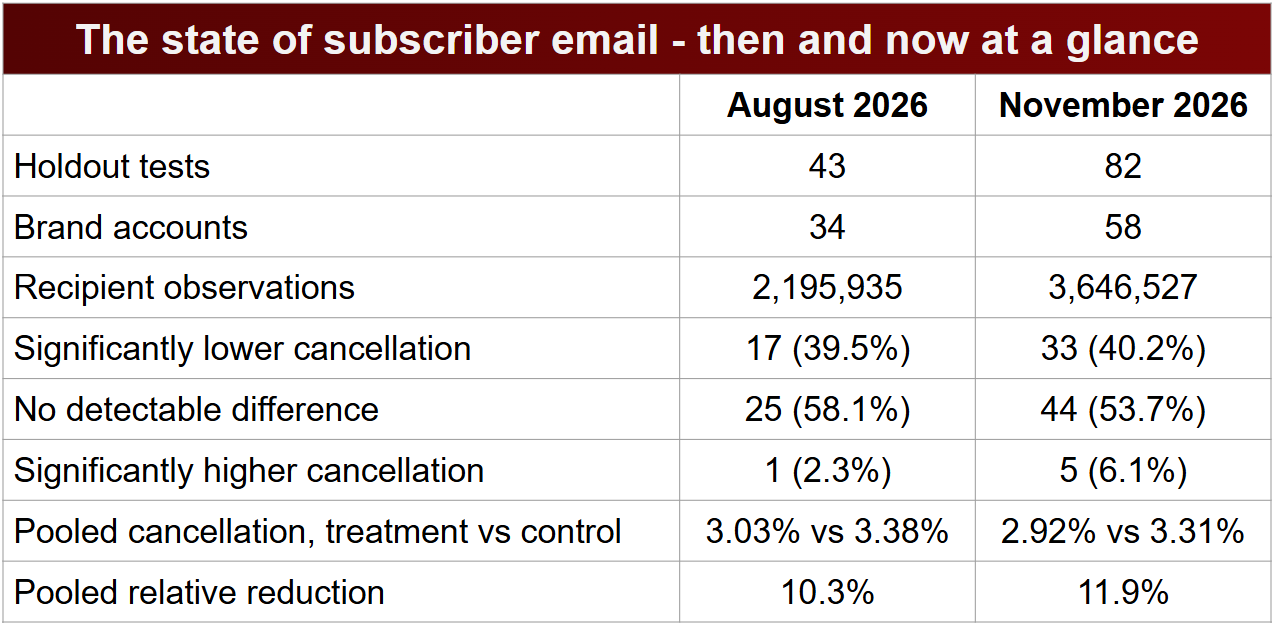
We’ve followed the same rules as we did in Aug 2026 - in every test, we compared an interactive email against a standard fallback version. Both groups get the email and at least 10,000 opens with a near 50/50 split. We tested for what the email lets a subscriber do.
One note before we dive deeper: Of the 42 additions, only 10 started after our August report. The rest were tests the original inventory had missed. So, in essence, this is a fuller picture of the same period.
What held up
The core claim held up after we doubled the data.
In August, 39.5% (17 of 43 tests) of tests showed significantly lower cancellation. In November, it's 40.2% (33 of 82 tests). Four wins out of ten means our initial hypothesis was on the right track - both in Aug and in Nov.
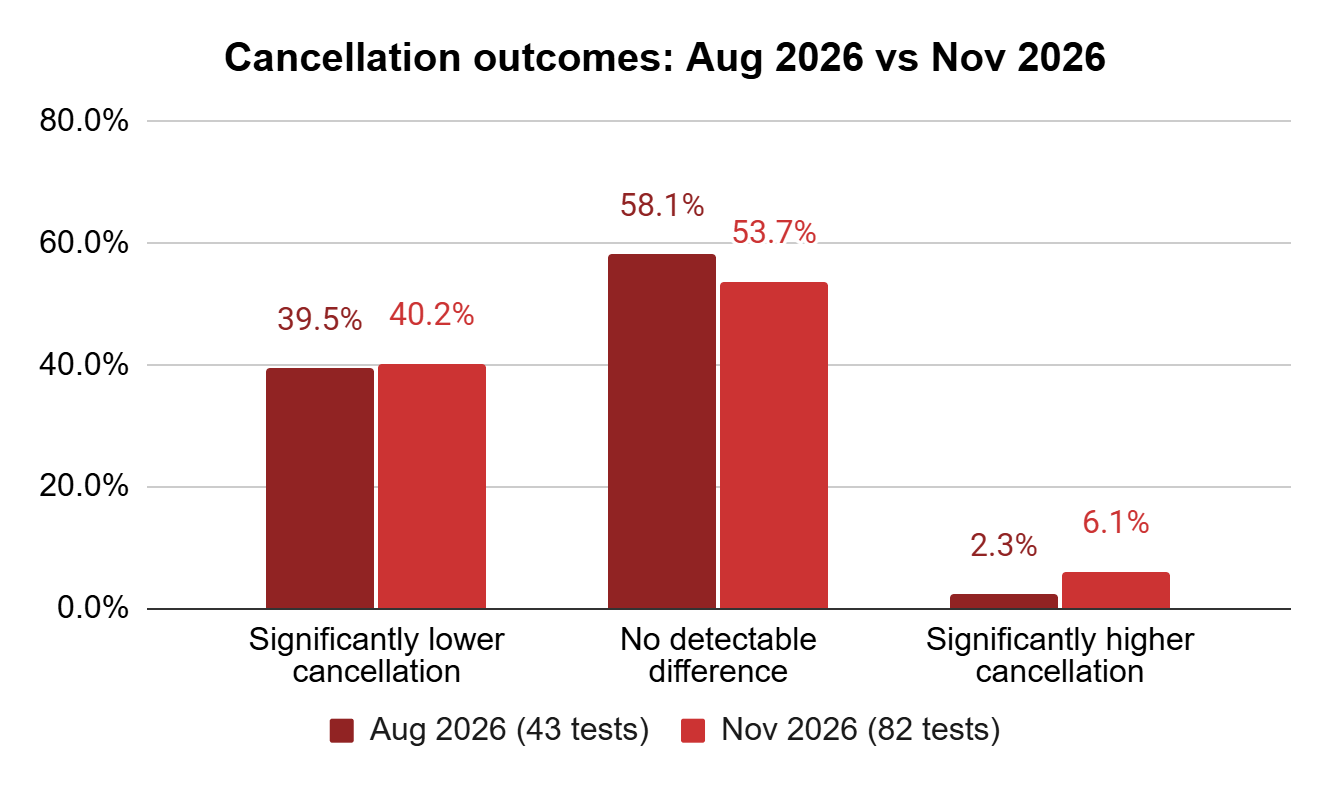
The most common outcome is still "no detectable difference". In Aug, it was 58.1% while in Nov, it fell marginally to 53.7%. Tests where the email increased cancellations are still rare: 5 out of 82. And 45 of the 58 brands lean towards lower cancellation overall.
So the conclusion is the same as August: Adding delay, skip, swap and add-on options to your subscriber emails is still close to a free bet because it rarely hurts to try them.
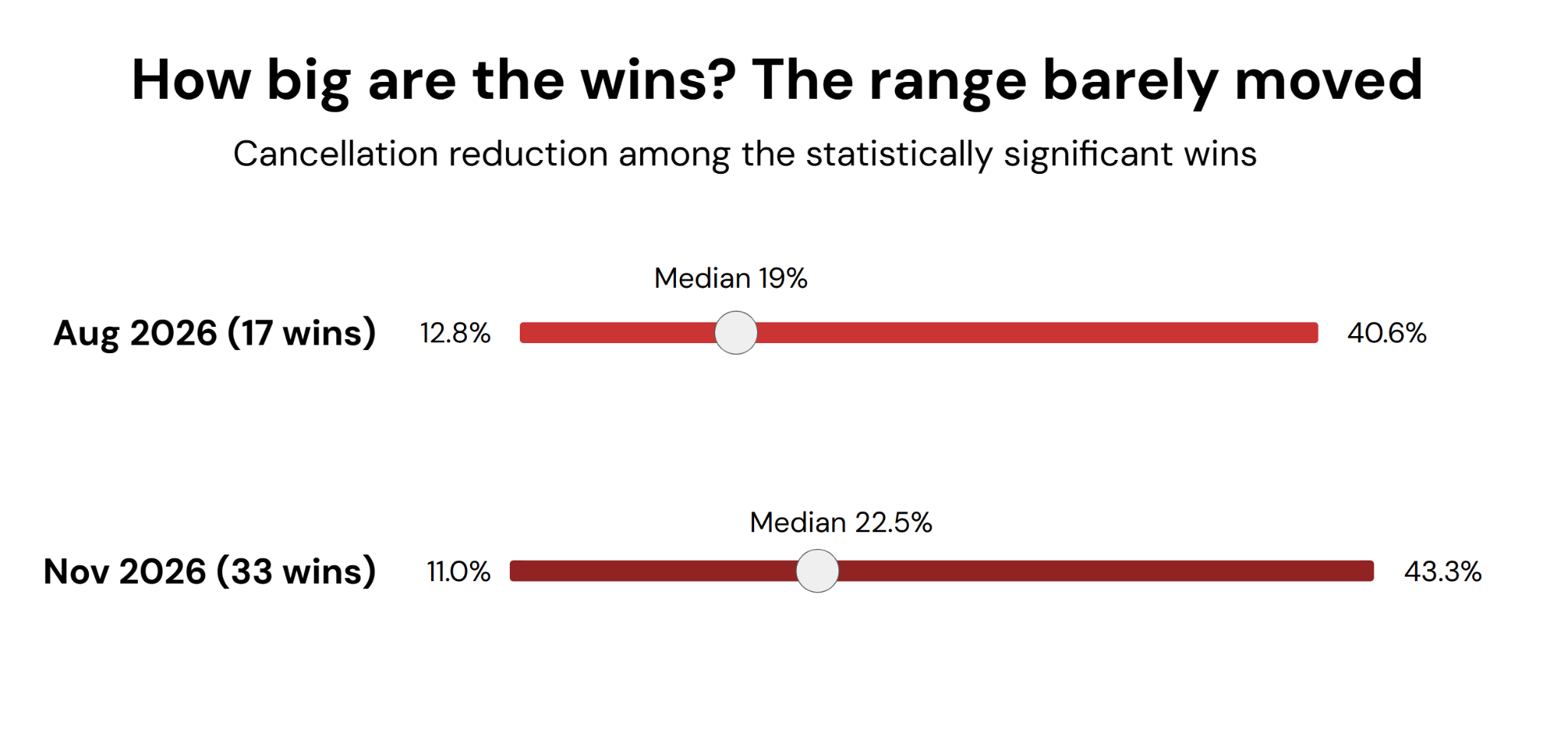
And when it works, it works by a lot: the 33 winning tests cut cancellations by between 11% and 43.3%, and the typical win was 22.5%.
What changed in three months?
Two things.
1. The failure count went up
Five tests now show significantly higher cancellation, up from one last time.
We don’t think it’s because the product got worse. The 40 tests we kept from August actually look marginally better now than they did then.
The new failures came from tests the original inventory missed. When we looked under the hood, we found more of everything.
2. Pooled relative reduction rose marginally
The pooled relative reduction - the overall cancellation gap when you combine every test into one pot - rose from 10.3% to 11.9%.
But that is not an improvement. Why?
Because between August and November, 42 tests joined the pool and 3 left. Think of it like a class average going up after 42 new students join and 3 leave: the average changed because the class changed, not because the students got smarter.
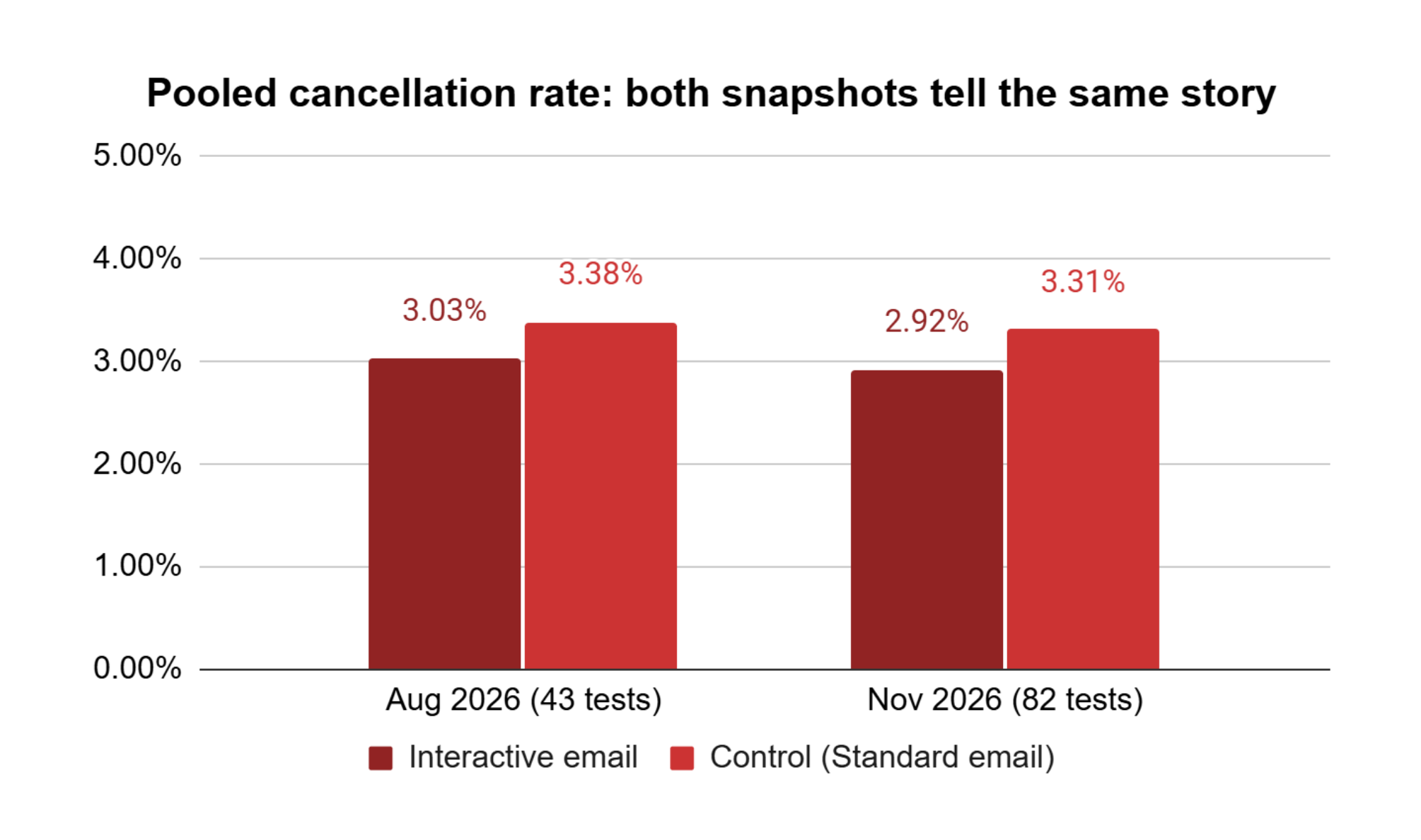
To check whether the original emails actually improved, we compared the 40 tests that appear in both snapshots, on identical terms. Their number didn’t rise at all - on the contrary, it slipped slightly, from 11.8% to 11.4%.
So the headline moved because the pool changed, not because the emails got better.
The best brand in our data sent one email that backfired
This is the most important new finding in our research.
One brand account now has eight qualifying tests. Seven show significant cancellation reductions which is the biggest in the entire pool.
The eighth shows a significant 17% cancellation increase.
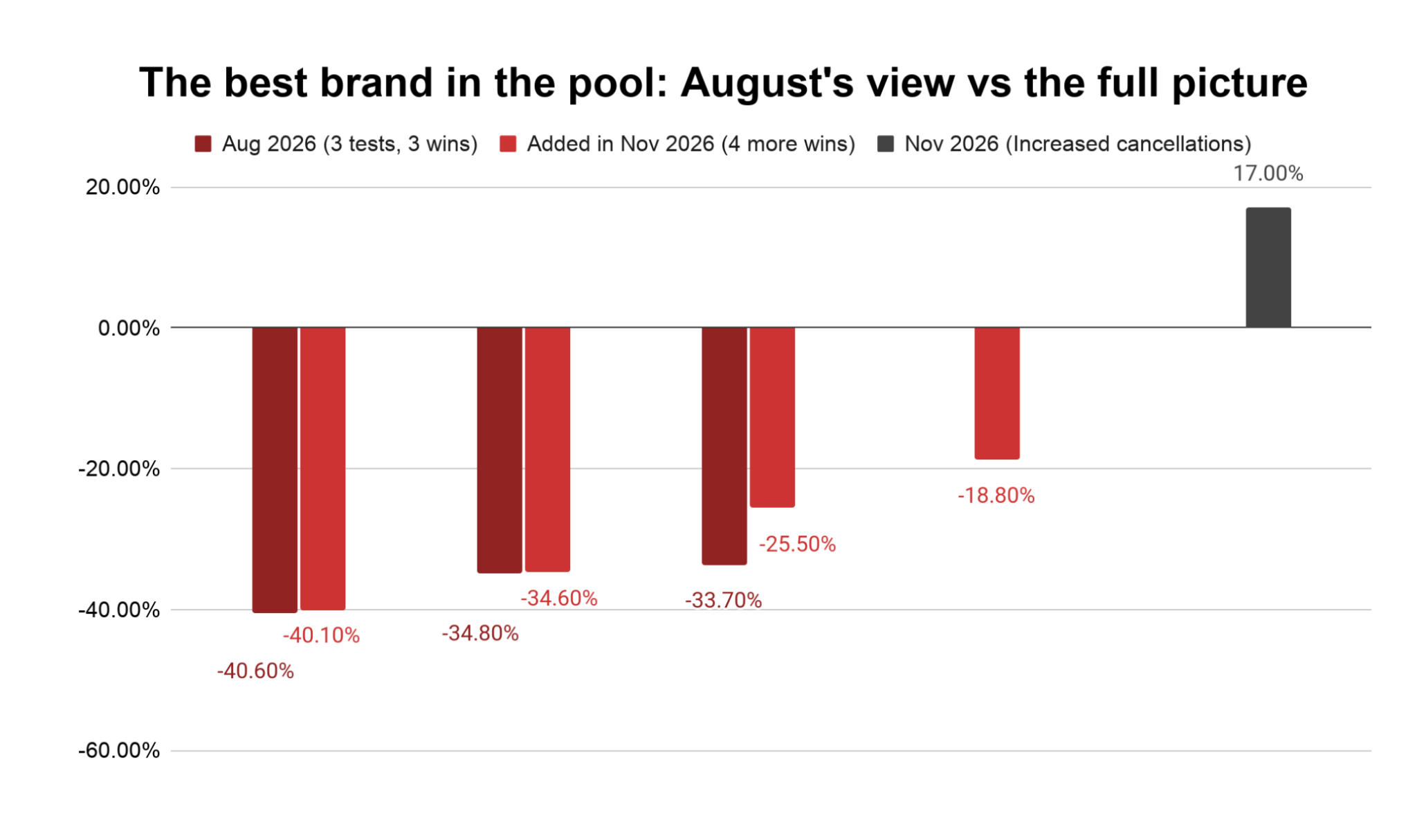
But don’t be quick to judge this observation on its average because it's the best interactive-email account in the dataset. A lot of DTC brands will probably roll the approach out everywhere without a second thought.
In August, our counterexample was one odd brand. You could conclude that "it works unless your setup is broken". But this time, it comes from inside the best-performing account we have.
The lesson for every DTC brand: A winning programme doesn't certify your next email. In fact, brand-level averages are where your bad messages hide.
So test at message level every time even after you've won.
It was never just the delay button
In August, we reported that brands where customers delayed more shipments tended to cancel less. The delay data now covers 69 of the 82 tests.
We now know that the delay button was never the magic wand. What moves retention is the whole experience of control: swaps, frequency changes, add-ons, and the customer's expectation that your brand makes their life easy.
That was the same conclusion in our DTC billing reminder playbook with Brice Douglas: the reminder doesn’t cause churn but the lack of flexibility surely does.
If you've been treating "add a delay button" as the entire strategy, the data says you've been chasing a feature instead of a retention programme.
Meanwhile, brands are splitting on email volume
Our recent research data produced the most interesting behavioural shift in the update.
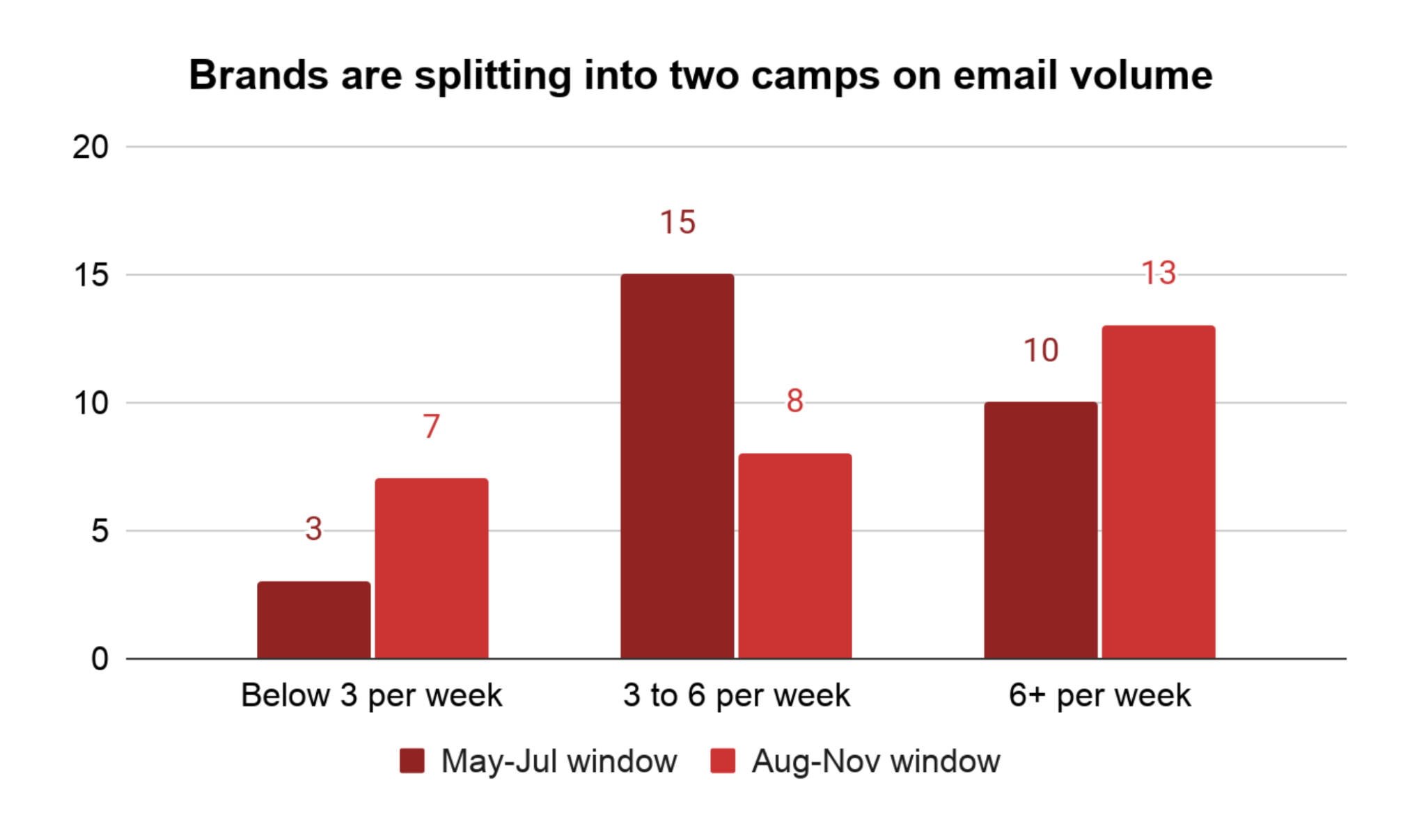
We tracked the same 28 brand accounts across two 90-day windows: May to July, then August to November.
Here's what happened:
Three months ago, more than half of these brands (15 of 28) sent a moderate 3-6 campaigns a week.
Now only 8 of them do.
The rest moved to one extreme or the other:
- Brands sending under 3 campaigns a week went from 3 to 7
- Brands sending 6 or more went from 10 to 13
The typical brand still sends about 5.5 campaigns a week.
Why? Presumably one camp read that more email is the answer, and the other read that restraint is.
Both camps are pulling the wrong lever.
82 tests now say the outcomes that matter are decided inside the email, not by the send count.
DTC brands seem to be arguing about the thing the data cares about least.
New public evidence since Aug 2026
Zaymo published five case studies since the last report and here’s what we found from them:
Heights: earn more without another send
Heights added one-click products to an existing billing reminder.
Result: 760% higher upsell revenue from that flow, 8.6 times control, in a roughly month-long A/B test.
No new email and no extra frequency. The same email with more flexibility inside.
One caveat: the public case doesn't share absolute figures, so treat it as a flow-level result. Heights also collected over 1,000 reviews in a quarter through in-email review forms.
Ruff Greens: fixing the feared reminder
A controlled test across 31,065 subscribers: 15.8% lower cancellation (2.45% vs 2.90%, p=.012) by improving the billing reminder.
Ruff Greens' churn driver included something new to our list: customers confused about how the trial became a subscription. A reminder that explains and offers options beats a reminder that just warns of a charge.
Ultra: clicks went up this time
In August we argued that falling click rates can be a sign of success.
Ultra's test, run with New Standard Co, showed clicks rising 22%, with a different treatment: one that improves attention on the email rather than completing actions inside it.
What a click means depends on what the email asks the customer to do.
And a fourth, for completeness: a 9-figure wellness brand, kept anonymous in Zaymo's own case study, reported a 19.5% cancellation reduction across 25,892 subscribers.
What about the cost of unsubscribing?
A separate audit covered 193 million email exposures across 40 accounts, comparing enhanced sends against controls and counting completed unsubscribes within 72 hours.
The result: roughly 1.9 extra opt-outs per 10,000 sends. A 26% relative increase, from a low base (0.091% vs 0.073%). Spam rates didn't move.
Here’s what we understood from it:
- The absolute cost of email is small. 19 extra opt-outs per 100,000 sends won't sink a programme that's cutting cancellations by double digits.
- But it isn't zero, yet. More assertive email has a price, and your retention maths should include it.
Yes, we still don’t have an answer to "what does one extra weekly email cost me?" That needs a frequency experiment, and it still doesn't exist.
The playbook: V2
The conclusion we laid out in our August playbook still holds. Rebuild the upcoming-order email around flexibility. Add one-click add-ons to billing reminders. Time upsells by order count. Put a quiz in front of your dormant segment and measure actions instead of clicks.
Here's what the new data adds:
1. Test at message level, forever
The brand with seven wins and one loser is the proof. Every meaningful new variant needs its own control group. Winning streaks are where losing emails hide.
2. Upgrade an existing send before you add a new one
Heights earned 8.6 times more upsell revenue from an email that was already going out. Your billing reminder, shipping notices and post-purchase flow are sends your customers already expect. Make them do more work before you make more of them.
3. Put opt-outs on the retention ledger
Track completed unsubscribes per 10,000 sends, monthly, next to the gains.
4. Diagnose before you discount
Ruff Greens' proved that churn was due to confusion about the offer. If customers don't understand how the subscription works, no amount of flexibility buttons fixes it. Find out why people cancel before deciding which tool addresses it.
5. Ignore the frequency stampede
Your competitors are visibly scattering to the extremes on send volume. There's still no evidence either direction is the answer. The lever is inside the email.
What we still can't claim
This is what is still unchanged since August:
- The right number of sends per week
- What one extra weekly email costs in unsubscribes (the opt-out audit is nearby evidence, not that experiment)
- How much revenue each additional send brings in, and whether it's new or pulled forward
- Whether sending more improves lifetime value
Answering those still requires randomising how many emails each subscriber receives and tracking outcomes over an agreed window. Nobody has published that yet. Including us.
Here's what we can now say, with roughly double the evidence behind it.
Across 82 large controlled tests where both groups received the same email, giving customers useful actions inside the email, cut cancellations significantly four times in ten, rarely backfired.
Bottom line: The only way to know which result your next email produces is to test it against a holdout.
Frequently asked questions
Do interactive emails reduce subscription cancellations?
Usually or they do no harm. Across 82 holdout tests covering 3.6 million recipient observations, 40.2% of tests showed significantly lower cancellation when subscribers could delay, skip, swap or add products inside the email, 53.7% showed no detectable difference, and 6.1% showed higher cancellation. Among the significant wins, cancellation fell by 11% to 43.3%, with a median of 22.5%.
What is a holdout test in email marketing?
A holdout test splits your audience into two groups: one receives the email (or feature) being tested, the other is held back as a control. Comparing the two tells you what the email actually changed. In this research, both groups received the same email and only the interactive functionality differed, so the tests measure the email experience, not send volume.
Do billing reminder emails cause subscriber churn?
No - badly framed ones do. In Ruff Greens' controlled test across 31,065 subscribers, an improved billing reminder cut cancellations by 15.8%. The recurring churn drivers are too much product on hand and confusion about the subscription itself, so a reminder that offers delay, swap and frequency options turns a churn moment into a retention moment.
How many emails per week should a DTC brand send?
There is no evidence-based answer, and anyone quoting one is guessing. The typical subscription brand in this dataset sends about 5.5 campaigns a week, but that describes behaviour, not an optimum. Across 82 controlled tests, the outcomes that mattered were decided by what the email let the customer do, not by how many were sent.
Do more aggressive emails increase unsubscribes?
Slightly, and now it's measured. An audit of 193 million sends found roughly 1.9 extra completed opt-outs per 10,000 enhanced sends versus controls - a 26% relative increase from a very low base. Spam rates didn't move. The cost is small, but it belongs in your retention maths.
Did interactive email get more effective between August and November 2026?
No. The headline pooled reduction rose from 10.3% to 11.9%, but that's because the pool of tests changed. On the same 40 retained tests with fixed weights, the number moved slightly the other way (11.8% to 11.4%). The honest reading: the result is stable, not improving.
Can interactive email ever increase cancellations?
Yes. Five of 82 tests showed significantly higher cancellation, and one of them came from the best-performing brand in the dataset - an account with seven significant wins. That's why every new message variant needs its own holdout test, even at brands where the approach is already working.
Research methodology
82 interactive-versus-fallback A/B comparisons with cancellation outcomes, drawn from 58 brand accounts and 3,646,527 recipient observations (summed exposure, not unique people), outcomes through 26 October 2026. Rules unchanged from the August report: 10,000+ recorded opens, realised treatment share between 45% and 55%, two-sided 95% significance threshold, cumulative observation windows (now 25-607 days, median 182).
Of the 42 added tests, 27 fill gaps in the original inventory, 5 newly passed the thresholds, and 10 started after 4 August; 3 August tests exited because their allocation drifted outside the 45-55% rule, including the original negative outlier - its exit is a rule outcome, not evidence the negative effect resolved.
The 11.9% pooled figure describes this pool, weights large tests more heavily, and is not a promised lift; a fixed-weight check on the 40 retained tests moved from 11.8% to 11.4%, so no improvement over time is claimed. The cadence comparison uses the same 28 accounts in both windows and is a restatement with broader source coverage, not an exact reproduction of the original 22-account snapshot.
The opt-out audit (dated 6 October) is separate from the 82-test pool and measures completed opt-outs within 72 hours, not clicks on an unsubscribe link. Internal test brands are anonymised; public case studies are named using their published figures and original definitions, and are never added to the audited pool.
Related reads: