Your best marketing automations already exist.
They live in Klaviyo, they're built around what your subscribers actually do, and someone on your team has spent hundreds of hours getting the timing, imagery, copy and testing exactly right.
So when people ask me how to add direct mail into an owned strategy, the answer's simple.
Don't reinvent the wheel.
Add direct mail at the end of the flows you've already dialled in.
Below are the four I'd start with: welcome, abandoned cart and checkout, post-purchase, and winback, with examples and results from brands actually running them.
Email and SMS first. Then tag in direct mail.
Every play below follows one rule.
Email and SMS do the high-frequency work up front, and the postcard fires at the end of the flow.
So if your abandoned cart flow runs ten days with several email and SMS touches, the postcard goes out 5 to 10 days after that series ends, landing in-home once the inbox has already done its job.
For anyone who hasn't used direct mail yet, the real question is usually "how do we know it's actually working?"
Randall Elie, Director of Lifecycle Marketing at Awe Inspired, makes the case better than I can: "We think of Klaviyo and [direct mail] as sequenced, not competing. Awe Inspired sends a lot of email, and Klaviyo keeps owning the high-frequency digital work, but PostPilot picks up where that drops off. By the time someone's getting a postcard from us, they've probably already tuned out our emails. So there's no cannibalization worry."
And when the card does show up, it gets more than one look.
It sits on the kitchen counter for days, gets picked up by whoever walks past, and never lands in a promotions tab.
You can still run a holdout test to prove the incrementality of mail, which is exactly what the brands below did.
Automated retargeting: turning almost-customers into first purchases
Welcome flow: add a postcard after the series ends
Your welcome series is the highest-engagement window in the customer lifecycle, and the brands with the best welcome series drive serious money through it by leading with value, product education and recommendations.
A postcard can be an easy extension of that messaging.
It can include your highest-engagement assets. It can feature your hero product. It can echo whatever you're currently featuring seasonally in your welcome flow. It can carry the same offer as your emails and texts.
Take Cabana Life, a lifestyle brand selling UPF clothing whose imagery and messaging evoke time outside, especially around the beach.
Cabana Life automates a welcome card that lands in new subscribers' mailboxes just after their email sequence ends, a quick, holdable piece that captures the same imagery and messaging as the emails.

They're not overcomplicating it. They lead with sunshine, a happy person wearing a current-catalogue item, a reminder that the clothes are UPF 50+, and the same 25-off-100 offer repeated from the emails.
And it works. This automation has driven an 8.36x ROAS.
Abandoned cart: add a postcard to your highest-earning flow
Abandoned cart flows with email and SMS are routinely the highest-returning automation there is. Klaviyo's own data report proves it every year, and PostPilot's BFCM benchmark report shows the same pattern holding for direct mail.
The same framing rules from the welcome series apply here: strong copy, clear messaging.
The one real difference versus a welcome card is that postcards can't be dynamically printed to show the exact product someone abandoned, so your best product imagery, or your hero products, work just as well.
Cookware brand Made In is a good example. Last November, they fired this card 5 to 7 days after a cart was abandoned, offering 10% off a $100 order, a smaller discount than most abandoned cart offers get, especially over BFCM, and it still drove an 8.35x iROAS.
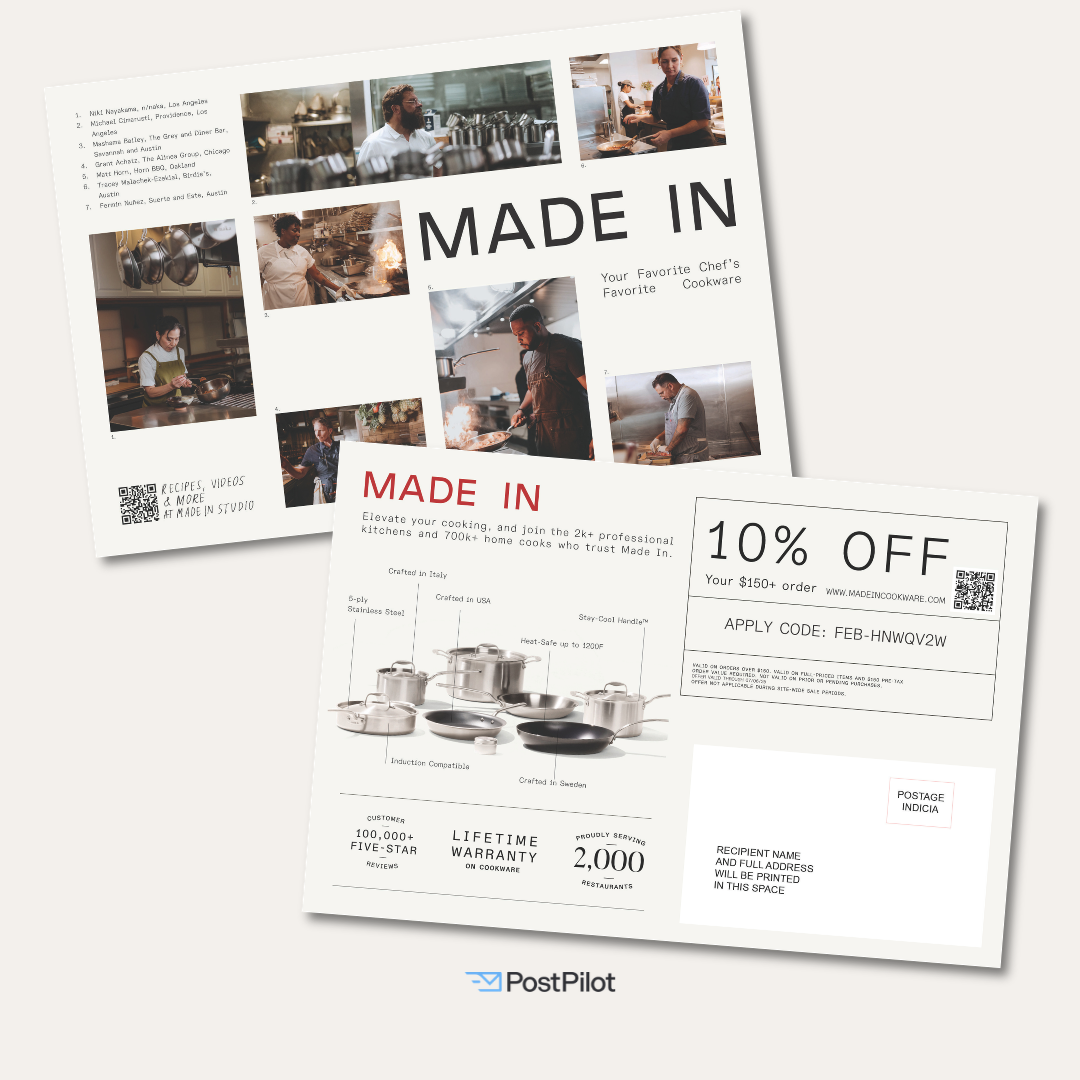
For most brands, the recommendation is the same: send the abandoned cart postcard 5 to 10 days after your email and SMS series ends.
Bonus: targeting checkout abandoners with postcards
If cart abandoners are red-hot leads, checkout abandoners are white-hot ones.
Abandoned checkout cards can be virtually identical to your abandoned cart postcards. The only difference is whether you keep the offer consistent with the abandon point in Klaviyo. Apples to apples, abandons to abandons.
If you don't make that distinction in Klaviyo, you can still split it out with separate touchpoints for carts and checkouts in PostPilot. Plenty of brands use the exact same card for both anyway, because the data says it rarely matters whether someone abandons checkout and then cart in the same journey.
Some brands go further and send mail at two separate checkout-abandonment points: before someone's entered payment or address details, and after.
Travelpro is the classic example. Last BFCM they were pushing hard on Meta to drive first purchases and wanted a postcard sitting at the closest point to purchase for almost-customers.

They added a card to the end of their holiday abandoned checkout flow in Klaviyo. Sent to checkout abandoners who'd never bought from Travelpro before, those cards drove 15x+ ROAS and turned more of that ad spend into first purchases.
Automated retention: getting the second order (and the third, and so on)
Post-purchase: time it to how your customers reorder
Post-purchase postcards work the same way as welcome cards.
The best ones offer an immediate next-purchase recommendation, the way welding brand Pipeliners Cloud does it: customers who bought a welding umbrella get offered the matching umbrella stand.
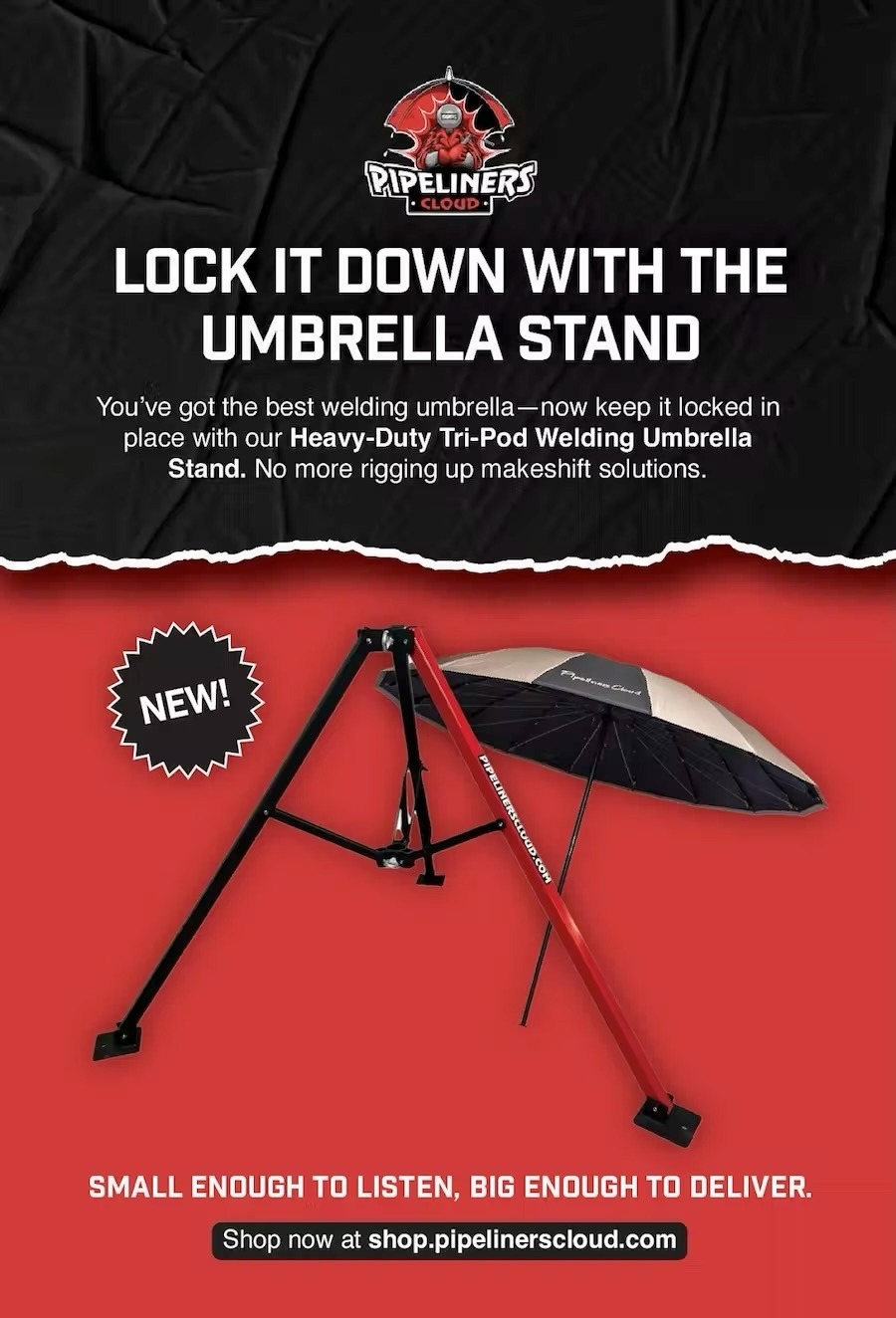
But a more general post-purchase message, one that just captures your flow's imagery and messaging and repeats your offer, works just as well.
Eyewear brand Caddis, whose customers skew a bit older, sends post-purchase postcards built around the same messaging, imagery and feel as its post-purchase email sequence. That's driven up to a 5.92x incremental ROAS.

Winbacks: put a card at the end of every winback flow
Here's the problem with winbacks, and you probably already know it: your winback emails have a reach problem, because the customers you most need back are the ones least likely to open them.
To be clear, that's not an argument for sending fewer winback emails. Email is still the backbone of any retention programme. But open rates aren't what they used to be, and for the people who've already stopped engaging with yours, direct mail does the job email can't.
Just like email, these postcards can run as always-on automations, triggered the moment someone hits a parameter, an RFM score, or simply time since their last purchase.
Retention might be the closest thing to a universally successful marketing tactic there is, and it gets genuinely interesting once you launch dedicated automated direct mail to your high-value lapsed customers.
Jewellery brand Awe Inspired sent lapsed high-value customers an automated card teasing an upcoming collection launch. That drove a 16.34x incremental ROAS.
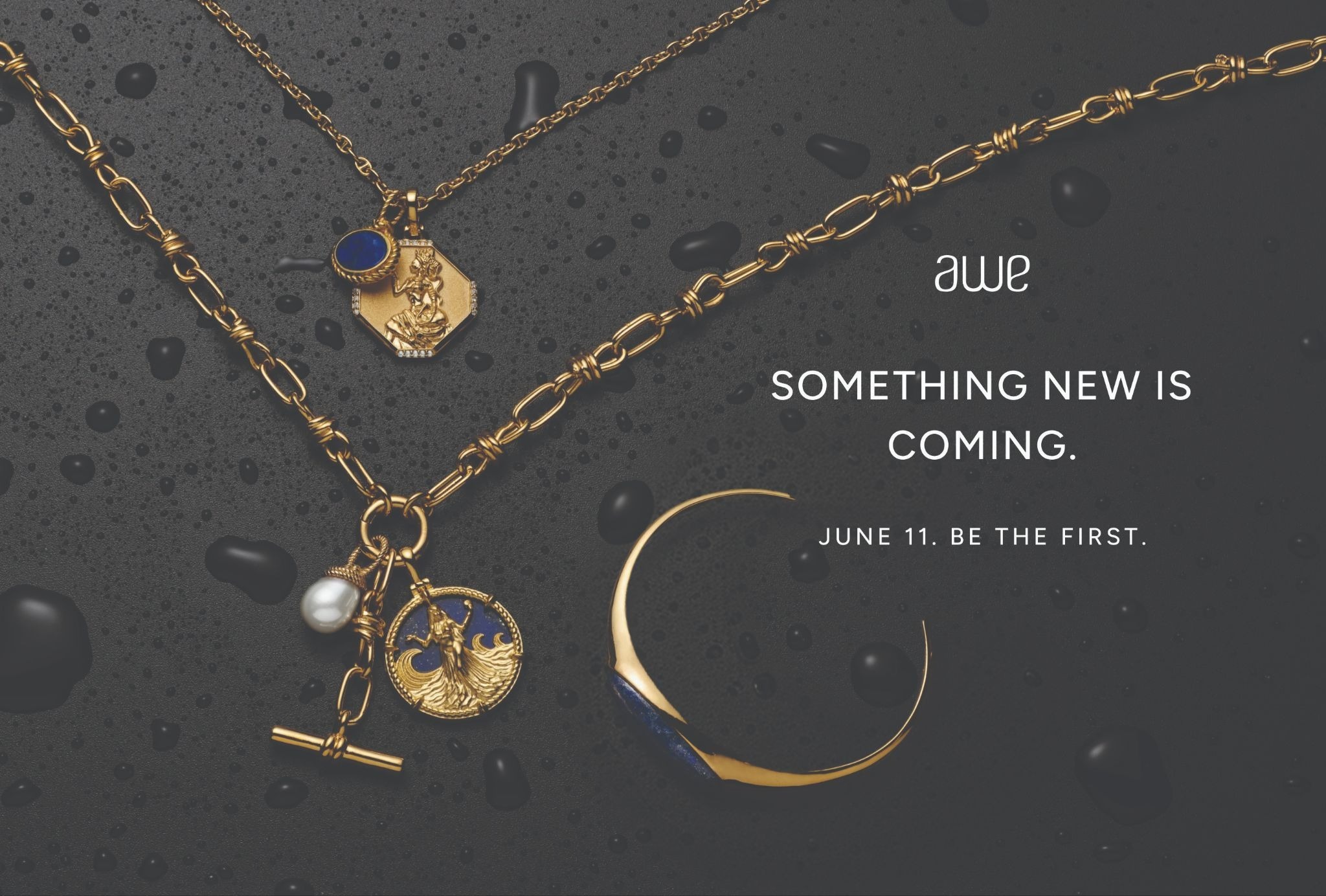
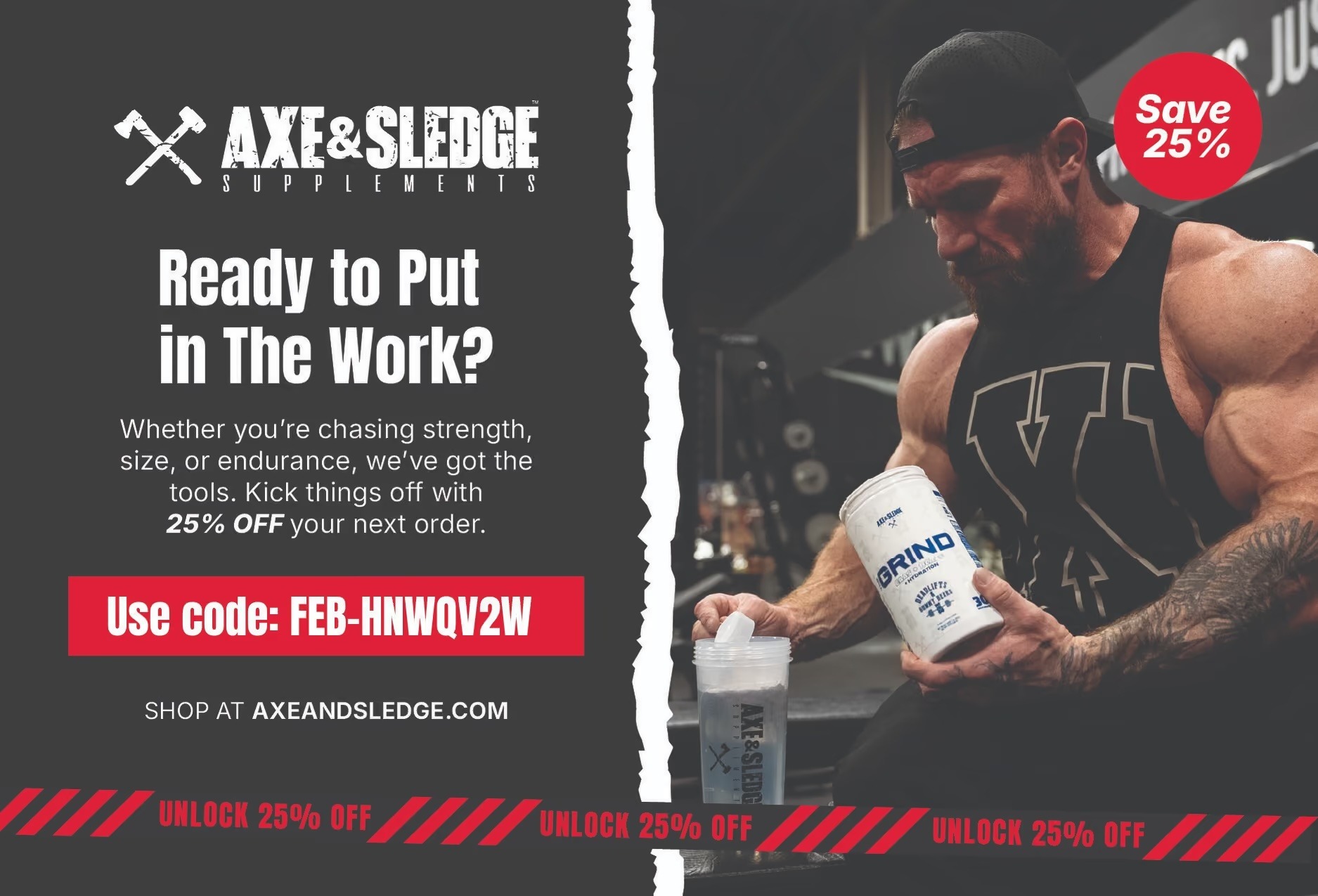
For a more classic winback, supplement brand Axe & Sledge sent high-value customers a blunt "come back" card with a dedicated 25% code. That automation has driven a 7.43x ROAS, firing cards and driving revenue around the clock.
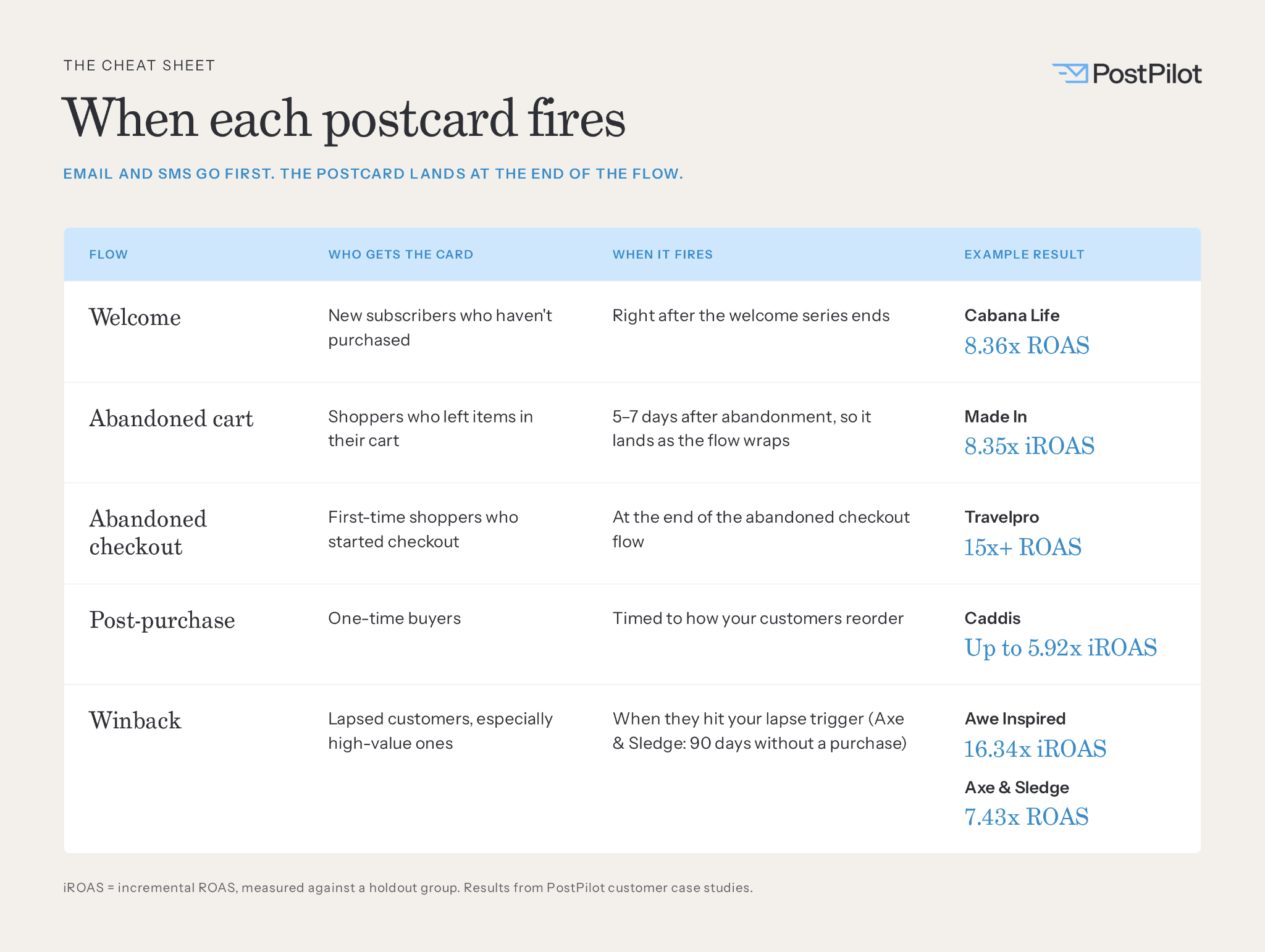
The direct mail cheat sheet: when each postcard fires
Email and SMS go first. The postcard lands at the end of the flow.
Measurement: make sure mail is actually driving results
If direct mail sits next to email and SMS in your lifecycle programme, it should answer to the same standard: did it drive revenue that wouldn't have happened anyway?
That's what holdout testing is for.
A randomised group gets no card, and the gap in conversion between that group and everyone who got mail is your incremental lift.
Connor Rolain, Head of Global Growth Marketing at HexClad, summed up why that matters: "PostPilot's incrementality tracking is the gold standard. It makes decision-making easy."
Every iROAS figure above comes from a holdout, run in-app, in real time.
Where this leaves your flows
You can launch this a step at a time. Start with the low-hanging fruit, abandoned cart and winback, and scale from there.
Don't be surprised if it ends up extending your whole Klaviyo lifecycle programme, direct mail acquisition included.
PostPilot is the platform behind every example above: a fully automated, AI-powered direct mail tool, and one of a handful of Klaviyo Premier partners.
If you want to see what your own flows would look like with a postcard at the end, book a PostPilot demo. And if the question runs the other way, where direct mail should sit inside your Klaviyo programme itself, that's exactly the conversation we have with our own clients.
FAQ
How do you add direct mail to an existing email and SMS strategy?
Don't rebuild anything. Tag a postcard onto the end of a flow you already run. Klaviyo keeps doing the high-frequency work up front, and the postcard fires once that series ends, reaching the subscriber whether or not they opened the emails.
Which flows should get a direct mail postcard first?
Welcome, abandoned cart, abandoned checkout, post-purchase and winback all work. But abandoned cart and winback are the ones worth starting with. They're sitting on the most immediate recoverable revenue.
When should a postcard go out after an abandoned cart?
5 to 10 days after your email and SMS series ends. That way it lands in-home once the inbox has already done its job, rather than competing with it.
Does direct mail cannibalise email performance?
No, by the time a postcard reaches someone, they've typically already stopped engaging with the emails covering that same moment. The two are sequenced, not competing for the same attention.
How do you know if a direct mail postcard is actually driving revenue?
Holdout testing. A randomised group gets no card, and the gap in conversion between that group and everyone who got mail is the incremental lift. That's the same standard email and SMS get held to.
What kind of ROAS can direct mail postcards drive?
It varies a lot by flow and brand. The examples in this piece range from roughly 5.9x to 16x incremental ROAS, but that's illustrative of what's possible with the right targeting and timing, not a benchmark to expect by default.
Also read: