"My agency keeps telling me email is 30, 40% of our revenue. But the business isn't actually improving."
I hear a version of this on almost every sales call.
The truth is it has nothing to do with sending more emails.
It's the ecommerce fundamentals that a lot of people in our industry never look at.
Let me repeat what I’ve said in the past: Retention is NOT a Klaviyo dashboard. It's five layers of a business stacked on top of each other, and email sits at the very top. The metrics that tell you whether your brand is healthy are CAC, true lifetime value, and the payback period - you can’t game any of them.
Why is Klaviyo attributed revenue not proof of retention?
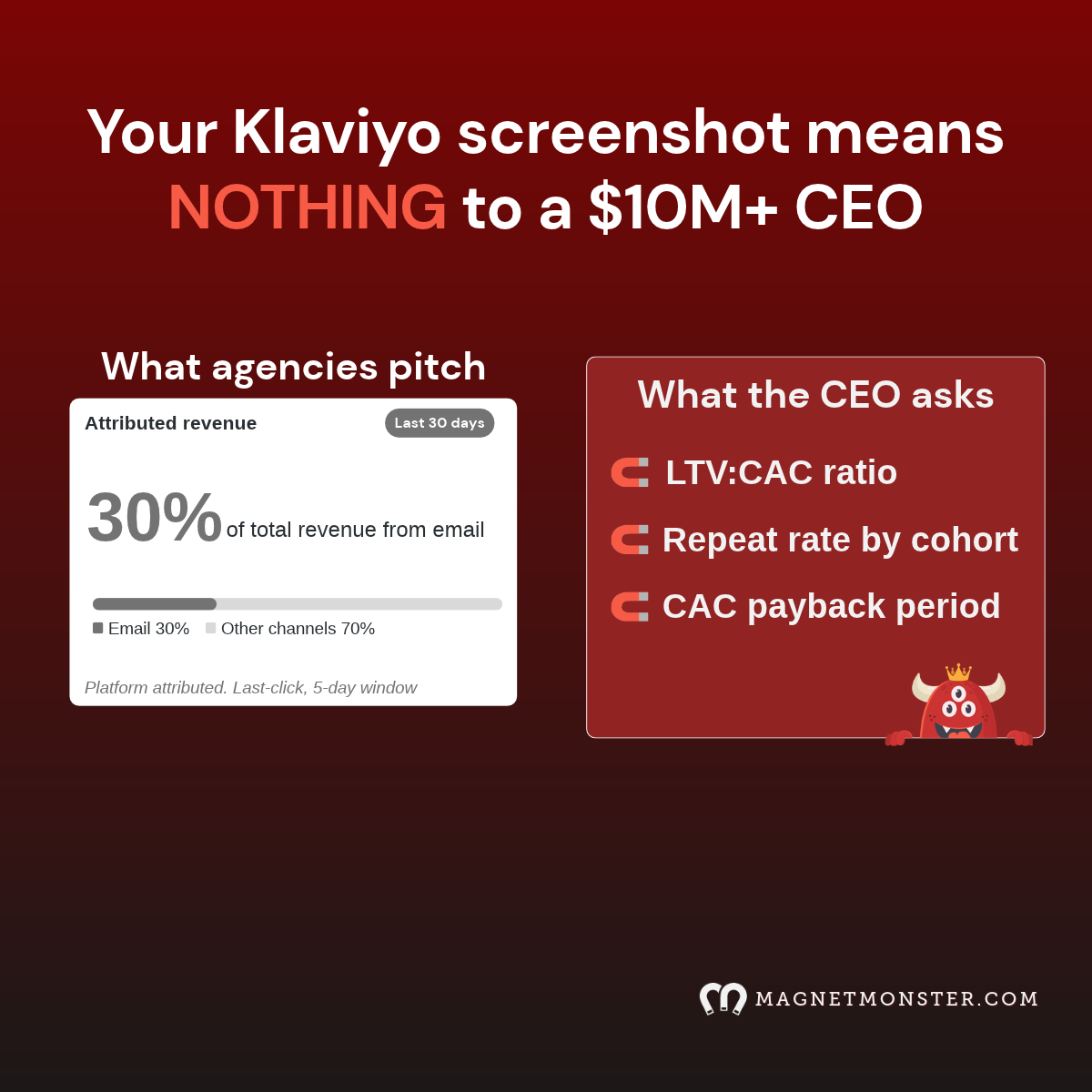
The easiest trick in our industry is: Turn off paid ads → Create lots of discount codes → Send tons of those codes to the list.
Your Klaviyo attributed revenue share rockets to 80, 90%, pretty much 100 if you want it to.
And the business dies anyway, because you've frontloaded revenue from customers who were already going to buy.
That's why I tell every brand during audits to reject the attribution screenshot from agencies as a source of truth.
Yes, we use it in reporting too because directionally, it's useful.
But I've watched Klaviyo revenue go UP while the brand's actual cohorts, the true measure of retention, were in decline.
An agency celebrating one number while the other falls is optimising for its own dashboard, not your business.
What is retention marketing, if it isn't Klaviyo?
Klaviyo is a channel.
The same way Meta is a channel and Google Ads is a channel.
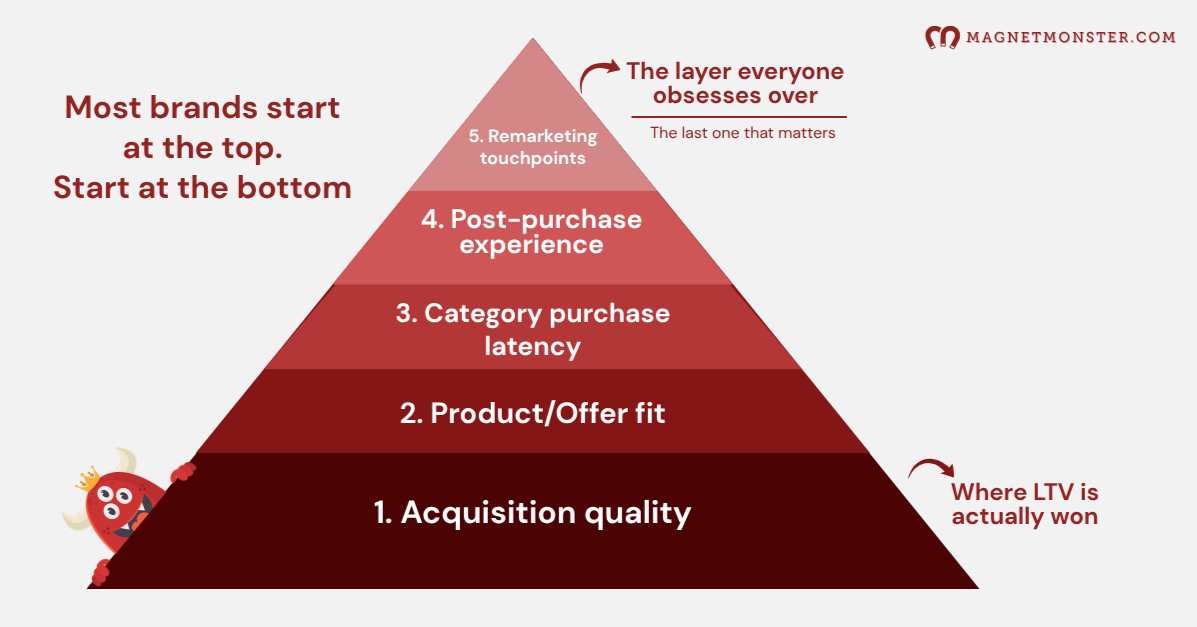
Real retention is five layers, stacked bottom to top:
- Acquisition quality
- Product and offer fit
- Category purchase latency
- Post-purchase experience
- Remarketing touchpoints (email, SMS, WhatsApp, direct mail)
Most agencies start at the top and work down.
We start at the bottom and work up, and the full retention playbook is built on that order.
Because the best campaign in the world is just lipstick on a broken funnel.
Why does acquisition decide your retention instead of emails?
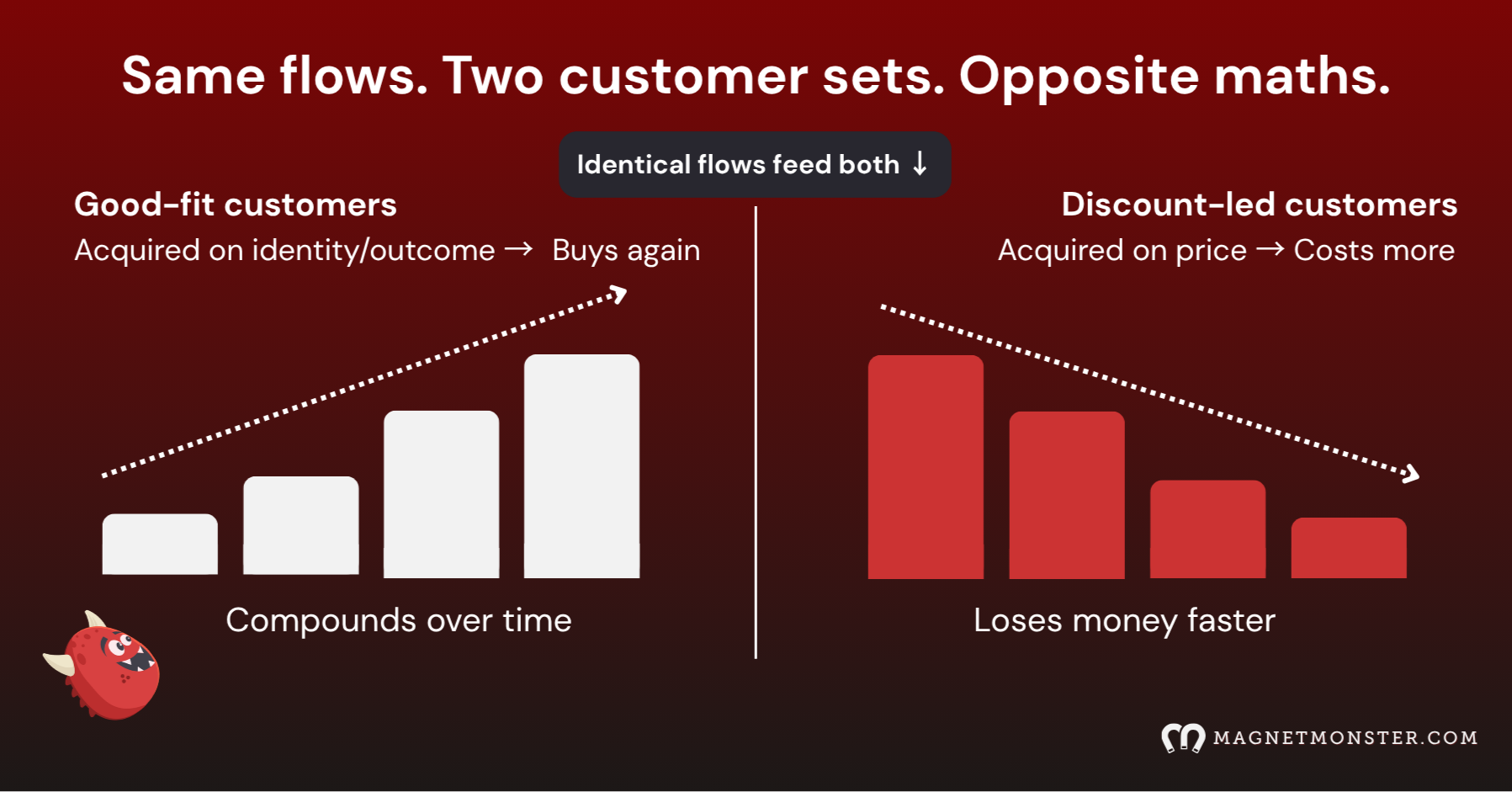
Here's the question I ask every brand during our audits: Have you bought a product because a Meta ad targeted them?
Everyone.
How many times did you buy it again if it was rubbish?
Zero.
Great marketing can get someone to buy but it cannot get them to buy again if the product didn't deliver.
And the highest correlation with lifetime value I see across every audit is alignment between why the customer bought and whether they got the result.
If you sell a fat-loss supplement to someone who doesn't lose fat, email sequences aren’t going to bring them back.
That's why turning a brand around almost always starts upstream of the inbox.
Can email change how often people buy?
No. Let me explain why with an example.
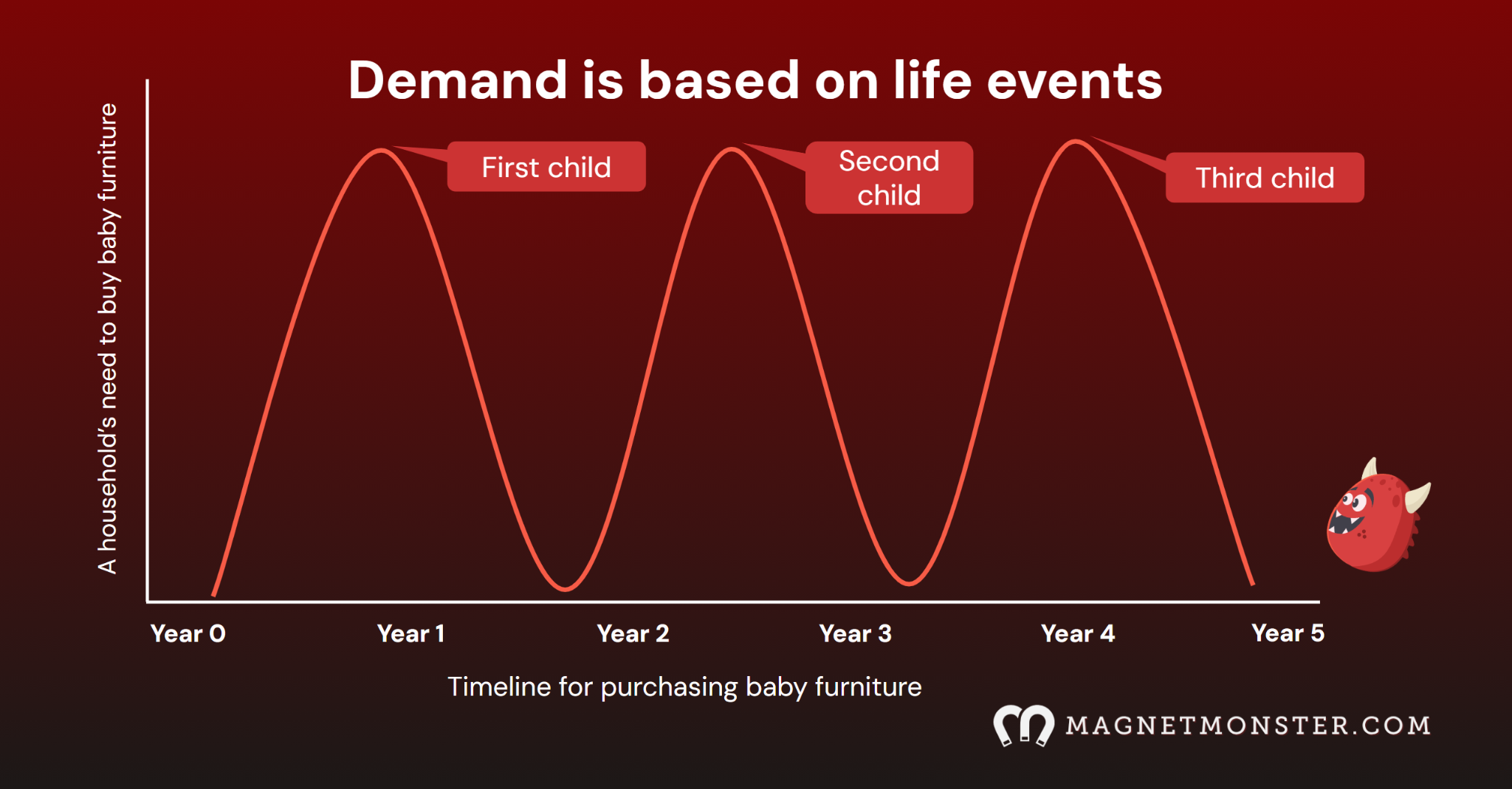
A few months ago, a brand selling children's bunk beds asked us to fix their repurchase rate. Now, how often does anyone need a second bunk bed?
A mattress can be a phenomenal product but nobody buys one every week.
Your category sets the purchase latency, and no campaign calendar changes the laws of physics.
So why advertise to people who aren't in the market?
Because when they come BACK into the market, you want to be the brand they remember.
That's what most advertising actually is: consistent touchpoints that build memory, so the buyer defaults to you when the need returns.
It's also why discounting someone immediately after purchase is so dangerous. Offer 80% off today to a customer who'd have paid full price in 30 days, and you've destroyed your own margin to log a sale you already had.
What's the first chart we pull on any brand?
It’s the new customer revenue vs returning customer revenue.
I open it on every audit and every sales call.
One real example, anonymised: a brand doing 932 new customers and $180K in new customer sales one year, then 500 customers and $90K the next.
Returning customer revenue was carrying the whole business. Yes, on paper, that looks like retention doing its job.
In reality, that brand was walking to a slow death.
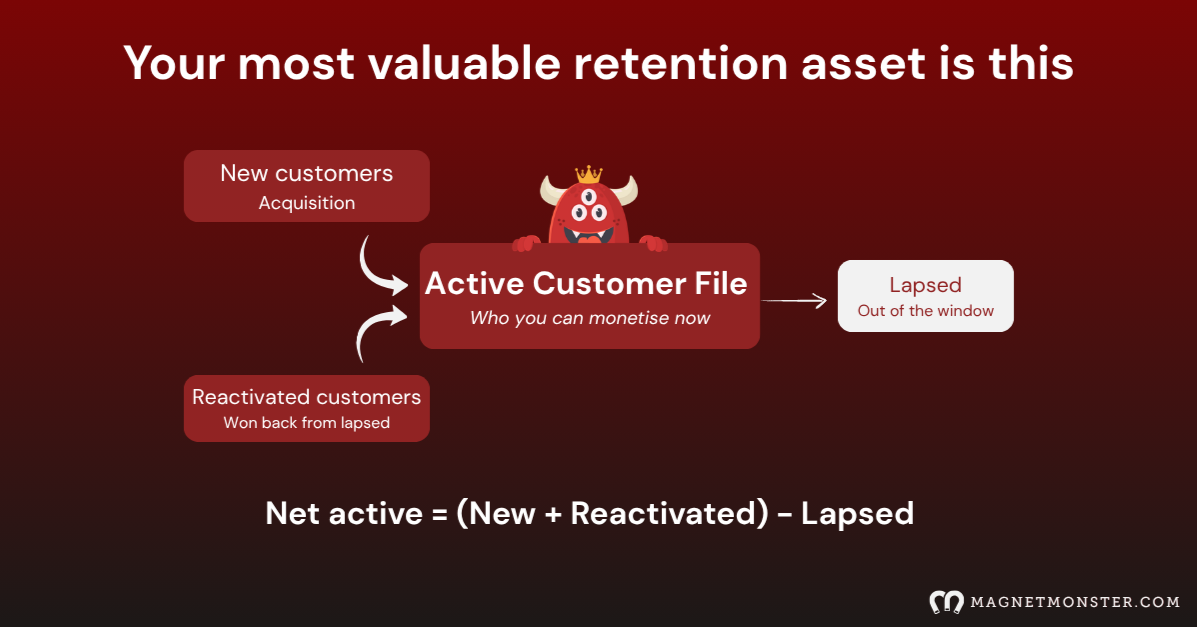
Because every brand has an active customer database: the pool of customers still inside their repurchase window. Three months, six months, twelve, depending on what you sell.
Once they fall out of that window, the only way to replace them is new acquisition.
You cannot milk existing customers forever. Customers churn, change interests, buy other categories. Smaller brands aren't Nike; people simply forget them.
Retention and acquisition are inextricably linked. You can't have one without the other, and the retention metrics most brands measure wrong all trace back to this chart.
Which metrics actually tell you a brand is healthy?
Revenue is three numbers multiplied together: traffic, conversion rate, and average order value.
But the metrics that decide whether the business survives are these four:
- CAC: what you pay to acquire a customer
- LTV: what you keep from that customer after variable costs, over a fixed window
- CAC payback period: how long until the acquisition cost comes back as cash
- LTV to CAC ratio: whether the whole model is sustainable
This is exactly what CMOs and founders are staring at every day, and it's beyond the remit of most agencies, which is precisely why clients get frustrated and leave them.
If you’re keen to know how your numbers compare, read DTC subscriptions benchmarks we published with Loop Subscriptions.
What's the difference between lifetime value and lifetime revenue?
This is the most conflated metric in ecommerce.
Nearly every dashboard you'll ever see, Klaviyo, Triple Whale, the screenshots on LinkedIn, says lifetime value and means lifetime revenue.
Here's the difference, with simple illustrative numbers.
You sell boots at $100 AOV.
Manufacturing costs $25. That is a decent margin because most DTC brands aim for around 80% gross margin on the product, because advertising is so expensive.
Then the costs that slip everybody’s notuce: freight, payment fees (Shopify takes around 3% of every transaction), pick and pack, shipping, and returns, which run around 20% for most fashion brands.
Out of that $100, you keep roughly $54.
And that's before fixed costs: staff, software, rent, agencies.
Now watch how brands go bankrupt with this.
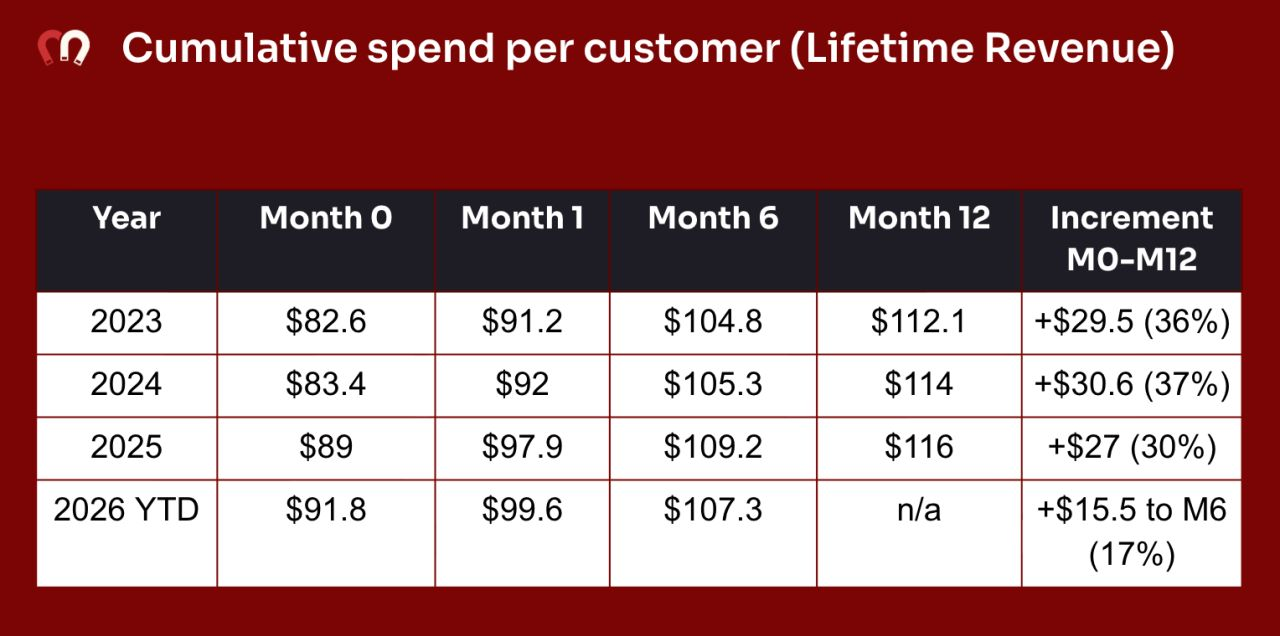
Your cohort data says customers spend $160 on average over 12 months. So you set an $80 CAC, because you'll "make it back".
But $160 is revenue, not value. After variable costs, that cohort returned about $6.40 per customer against your $80 spend.
If you set acquisition targets on lifetime revenue, your brand will go down even as every dashboard says you're winning.
Tools like Klar and StoreHero exist precisely so brands can plug in true costs and see actual margins. Use them.
And when you read cohort tables, track by order number, not calendar month, or the view lies to you.
Why does payback period beat LTV as a target?
Because you can be profitable on paper and still die waiting for the cash.
Two brands can have identical 12-month LTV.
One recoups its acquisition cost by month three. The other stays in the red until month nine.
The first can reinvest immediately: more customers, more growth, compounding.
The second is financing its own growth for three quarters of a year while Meta bills land every week.
It's the same in any business. Invoices on net 60 or net 90 terms don't pause your staff salaries or software bills while you wait for the money to arrive.
Most brands we work with aim to recoup CAC within three months, and most of the retention work we do is really about pulling that repeat purchase window forward.
What's a healthy LTV to CAC ratio?
The working gold standard for LTV to CAC ratio is 3:1.
It is a good rule of thumb for a model that can pay its bills and reinvest in growth.
Here's why you watch it like a hawk: we audited a brand recently that had scaled hard: massive top-line revenue growth.
Their ratio went from 2:1 to 0.84 in 14 months.
Retention hadn’t gotten any worse, while lifetime value was flat.
Acquisition costs doubled, and the business model broke underneath them.
That's the trap of CAC: Meta and Google are auctions, more advertisers enter every year, and the price only trends one way.
Which leaves two levers. Lower your CAC, or raise your LTV, and the biggest LTV lever often sits on your storefront, not in your email account.
Why is the second purchase the whole game?
For a conventional DTC brand, a really good repeat purchase rate is 30%.
Which means around 70% of customers never buy again.
You can't get a third or fourth order until you've got the second. And once someone has bought twice, the habit is stickier and more repeatable.
So the second purchase is the main point of leverage, and the first 30 days is usually where it's won or lost.
Now watch what small changes do at scale, again with illustrative numbers.
A brand acquires 10,000 customers a month at $1M in net sales. By month six, that cohort has spent $1.3M.
If the repeat rate drops 10%, that's $100K less revenue, roughly $50K less profit at a 50% margin.
That is just from ONE month's intake. Every monthly cohort takes the same hit, so across a year you're compounding that loss twelve times over.
That's also the good news. Shift repeat rates by single digits and the same compounding works for you, which is exactly what our upsell playbook is built to do.
Where this shows up in your business
Everything above is diagnosable from your own data in under an hour.
If you run a subscription programme, we'll do it for you.
Our subscription audit digs into where the revenue is leaking, take rate, churn and recurring AOV, and turns it into an action plan you can execute with or without us.
Claim your free subscription audit
Frequently asked questions
Is Klaviyo attributed revenue an accurate measure of retention?
No. Klaviyo attributed revenue measures what the platform claims credit for, not whether customers are actually coming back. It can be inflated by turning off paid ads and sending heavy discount codes to the list, and it can rise while true retention, measured in repeat purchase cohorts, declines. Use it directionally, never as a single source of truth.
What is the difference between lifetime value and lifetime revenue?
Lifetime revenue is what a customer spends. Lifetime value is what you keep after variable costs: manufacturing, freight, payment fees, fulfilment and returns. Most dashboards label lifetime revenue as LTV, which is why brands set acquisition targets they can never afford. Always set CAC targets on lifetime value, not lifetime revenue.
What is a good LTV to CAC ratio for a DTC brand?
The working gold standard is 3:1, measured over a fixed window such as 12 months. It is a rule of thumb rather than a law, but a ratio trending towards 1:1 means acquisition costs are consuming the full value of each customer and the business model is breaking.
What is a good CAC payback period in ecommerce?
Most DTC brands aim to recoup their customer acquisition cost within three months. The faster the payback, the sooner cash can be reinvested into acquiring new customers. A brand can be profitable on paper at month 12 and still fail, because bills are paid with collected cash, not projected lifetime value.
What is a good repeat purchase rate for ecommerce?
For a conventional DTC brand, around 30% is a very good repeat purchase rate, meaning roughly 70% of customers never buy a second time. That is why the second purchase is the biggest point of leverage in retention: no third or fourth order exists without it, and single-digit improvements compound across every monthly cohort of customers.
Want more of this in your inbox? Subscribe to our newsletter and YouTube channel for weekly DTC retention strategies, extracted straight from the brands we work with. No fluff, just actionable plays.
Also read